


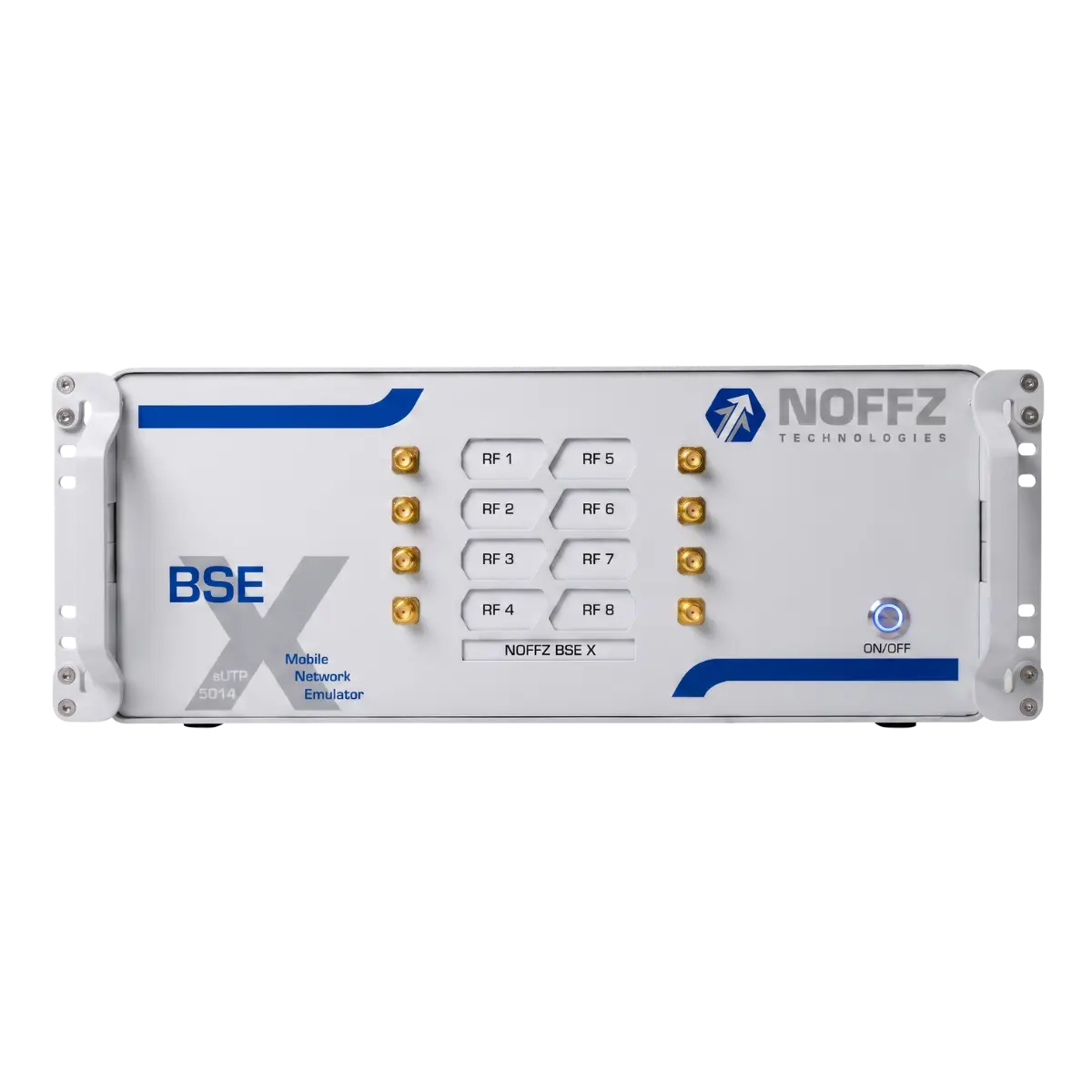
The NOFFZ Base Station Emulator (BSE) is a software-based mobile network emulator, built on software-defined radio (SDR) hardware, that recreates a complete private cellular network — 2G, 3G, 4G/LTE and 5G, across terrestrial and non-terrestrial networks (NTN) — in the lab or on the production line. It lets engineers test wireless devices such as telematics control units (TCUs), smartphones and IoT modems against a realistic network under full control of the signal conditions — no live carrier network or carrier subscription required (test SIMs are used instead). A single unit runs up to 4 independent cells and tests up to 32 cellular modules in parallel, including multi-day endurance runs.
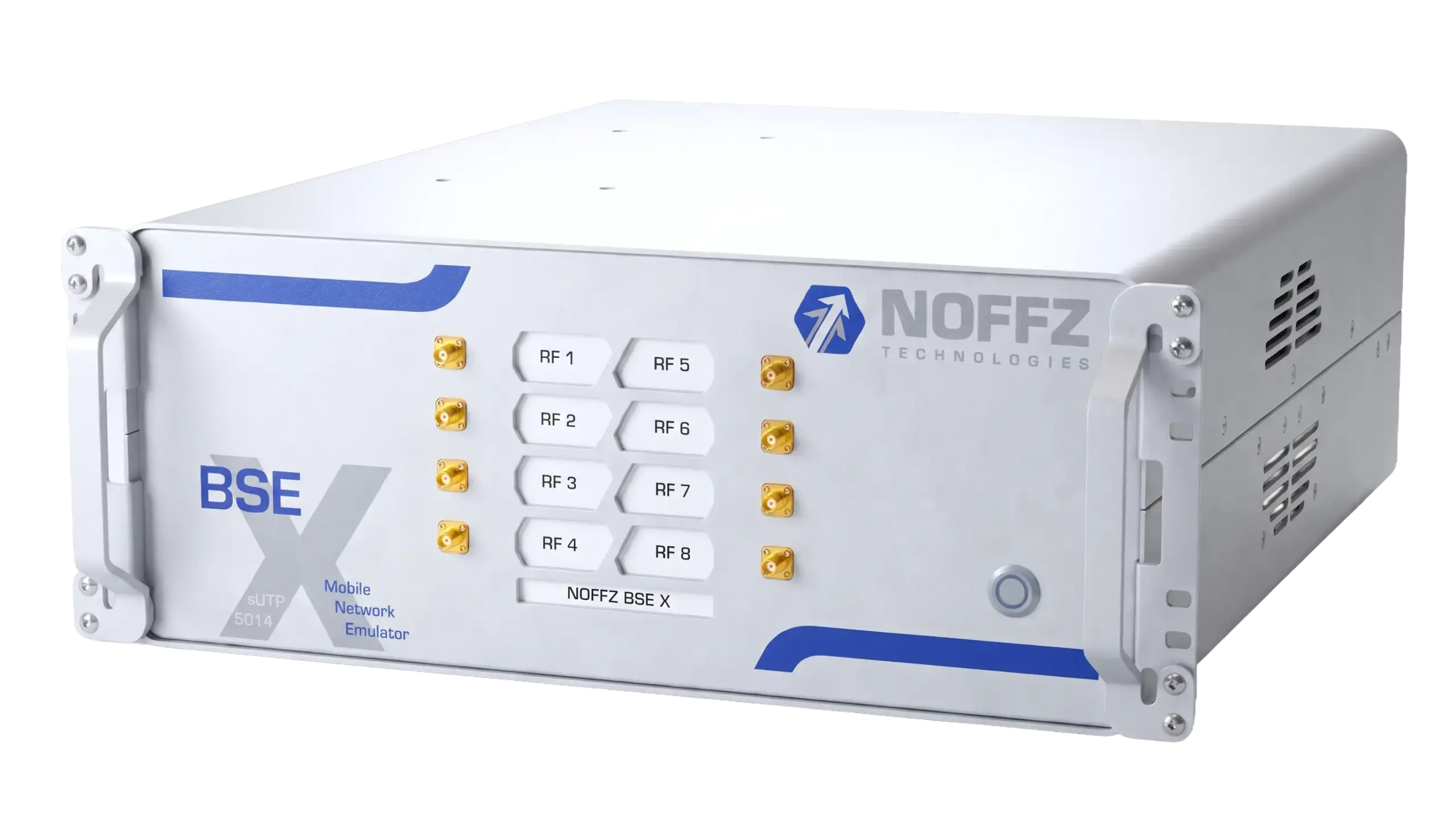
What is a mobile network emulator?
A mobile network emulator is a test equipment that mimics the network side of a mobile connection — the base station (eNB in LTE, gNB in 5G) and core network that a phone or module would normally connect to. The device under test attaches to it exactly as it would to a real cell tower, so engineers can trigger and verify calls, data sessions, handovers and emergency features in a controlled, fully repeatable environment. This device category is also called a base station emulator, callbox or signaling tester. Unlike testing on a live carrier network, an emulator gives complete control over signal conditions and total reproducibility — the same test runs identically every time.
What is the BSE X, and what happened to the sUTP 5018?
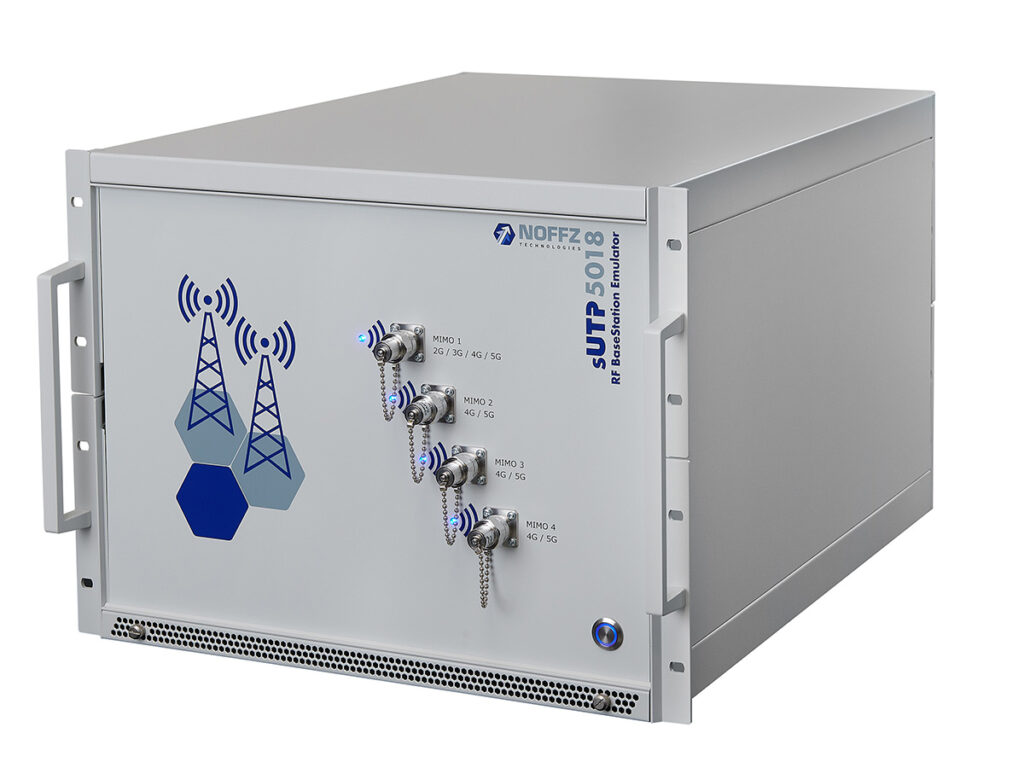
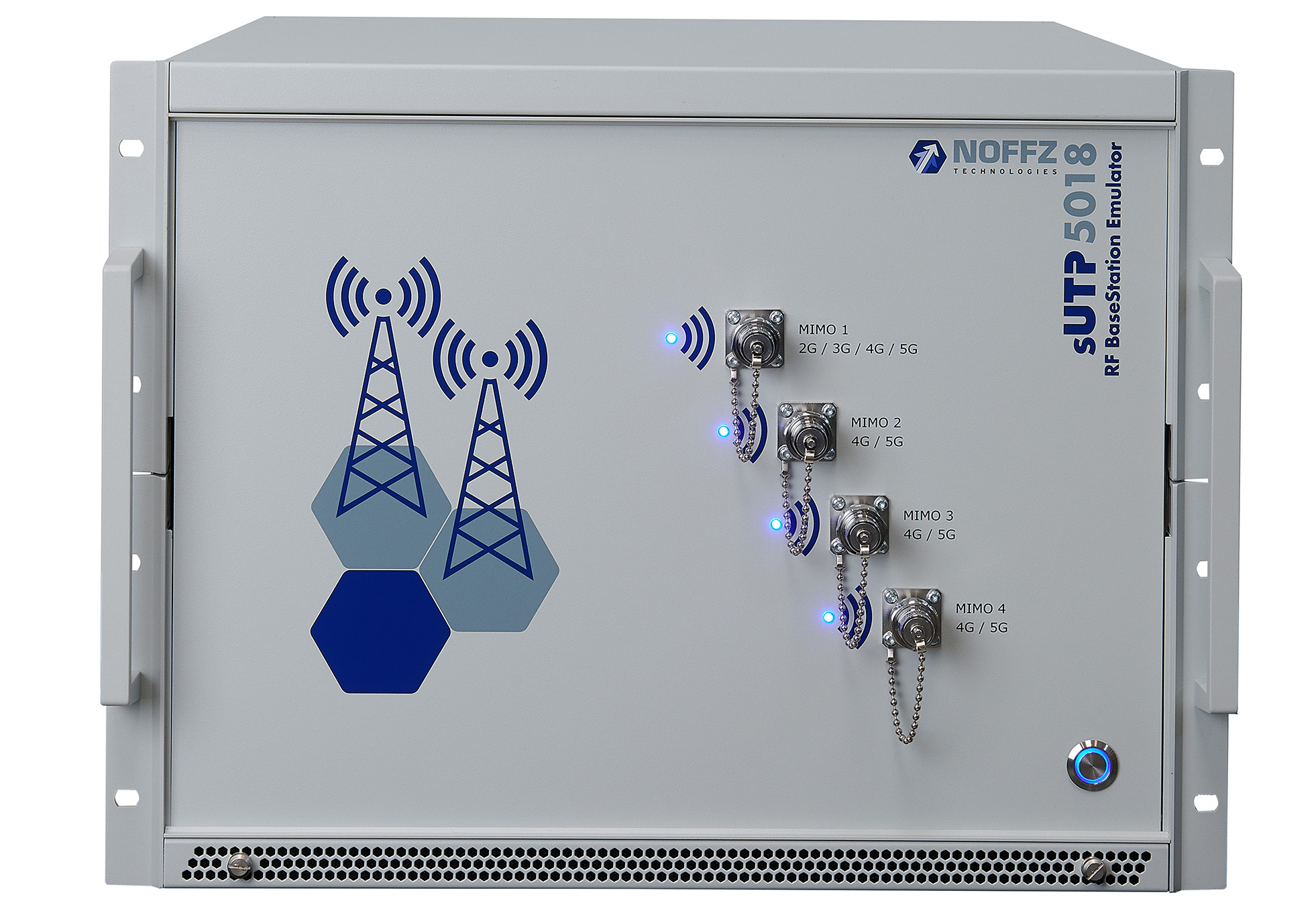
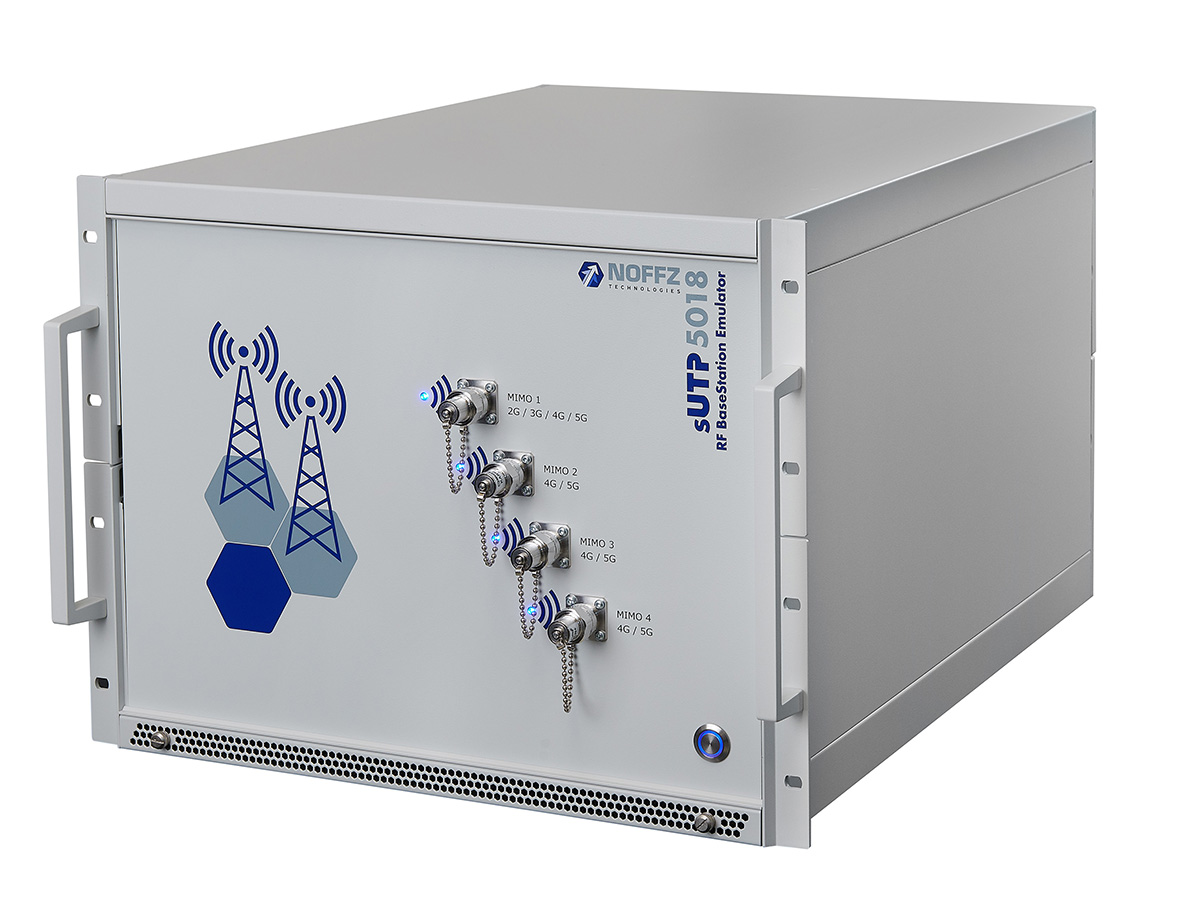
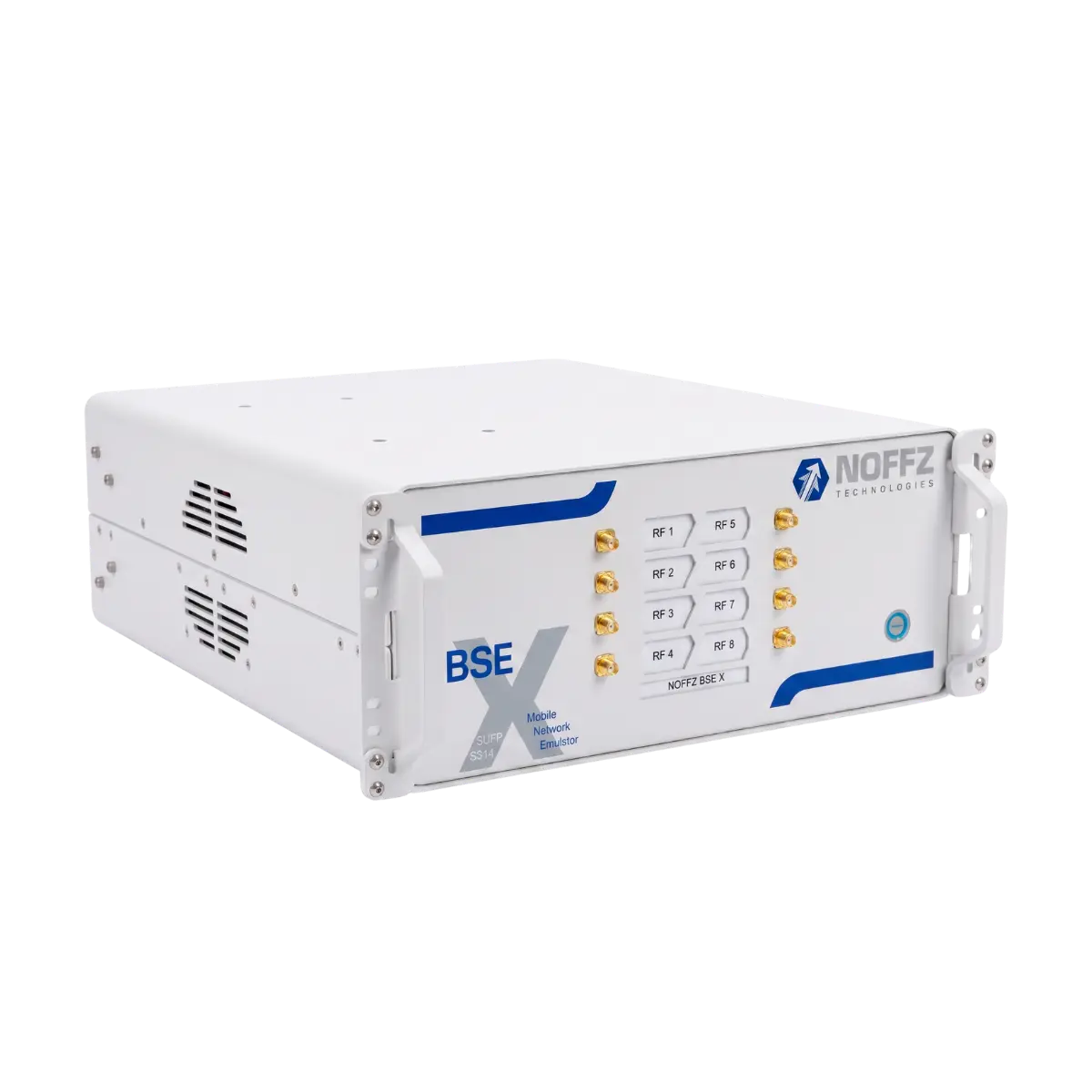
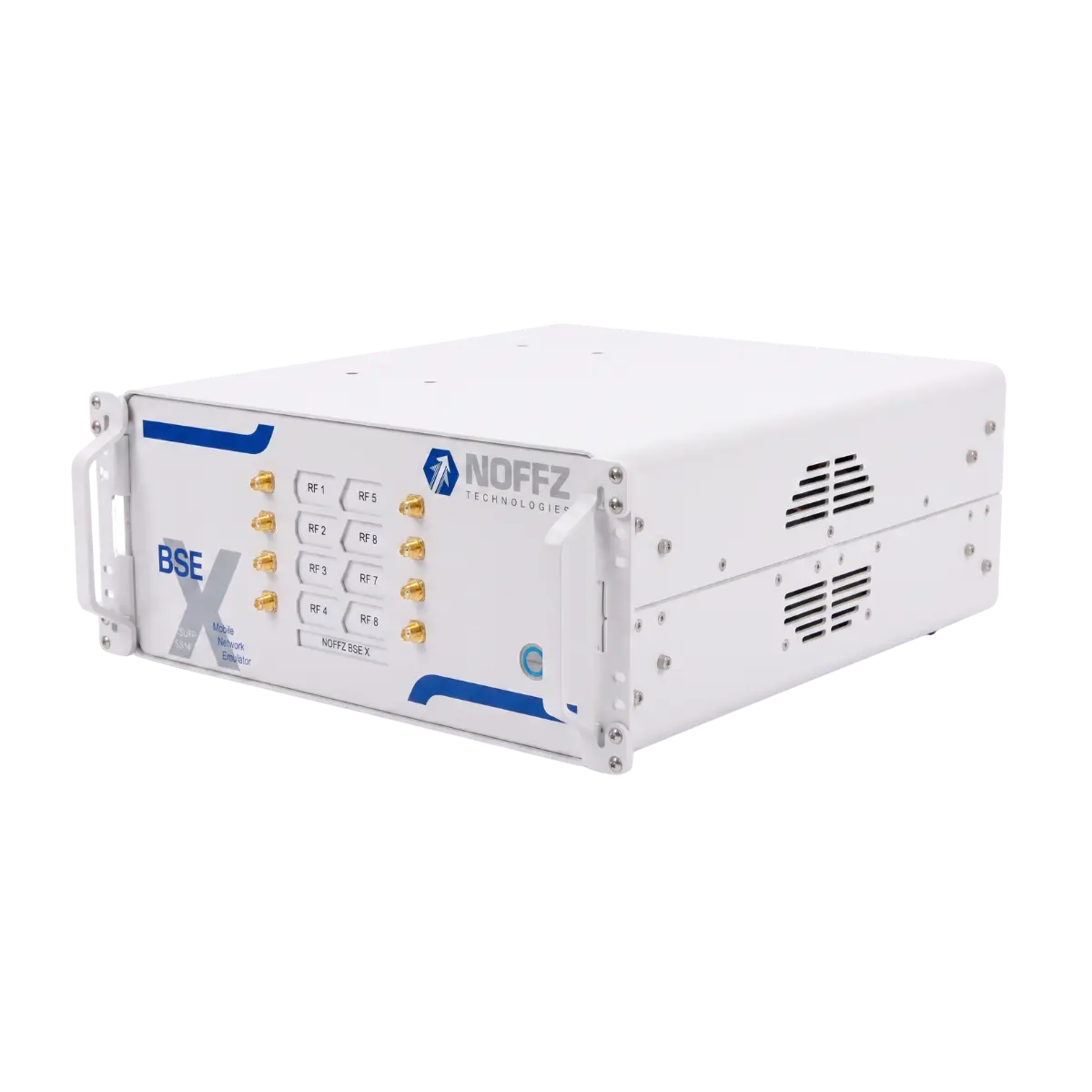
The BSE X (model sUTP 5014) is the current generation of the NOFFZ Base Station Emulator. It entirely replaces the previous generation, the sUTP 5018, with new dimensions, added functionality, a later 3GPP release level and non-terrestrial network (NTN) support. Existing sUTP 5018 documentation and links now refer to this page. The sUTP 5018 is in mature phase now. Orderable until December 2031.
What can you test with the BSE?
With the BSE, you test everything a device would do on a real mobile network — attach, calls, messaging, data, handovers and emergency calls — but under fully controlled, repeatable conditions. Tests run on a single device or on up to 32 devices in parallel, from a quick functional check to multi-day endurance runs.
Voice, messaging and emergency calls
Devices under test can make and receive voice calls and SMS, and place emergency calls including eCall and Next Generation eCall (NG eCall), exactly as on a live network. Emergency-call testing in particular benefits from emulation: you can trigger and verify eCall sequences repeatedly without ever touching a real emergency number.
Data and connectivity functions
Test maximum data throughput, VoIP, Wi-Fi hotspot and connected-gateway functions across 2G to 5G, including 5G SA and NSA. NB-IoT and LTE-M cells cover M2M and IoT devices.
Mobility and network scenarios
Configure up to 4 independent cells and move the device between them: intra-RAT handovers, handovers between 5G standalone cells, MIMO scenarios, and operator-switching with Dual-MME / Dual-MNO setups. Dual-SIM Dual-Active (DSDA) modules can be validated in parallel.
Satellite connectivity (NTN)
Validate IoT NTN and Direct-to-Cell (pre-Rel 17 D2C) behaviour in the lab, where satellite scenarios can be reproduced exactly.
Endurance and parallel validation
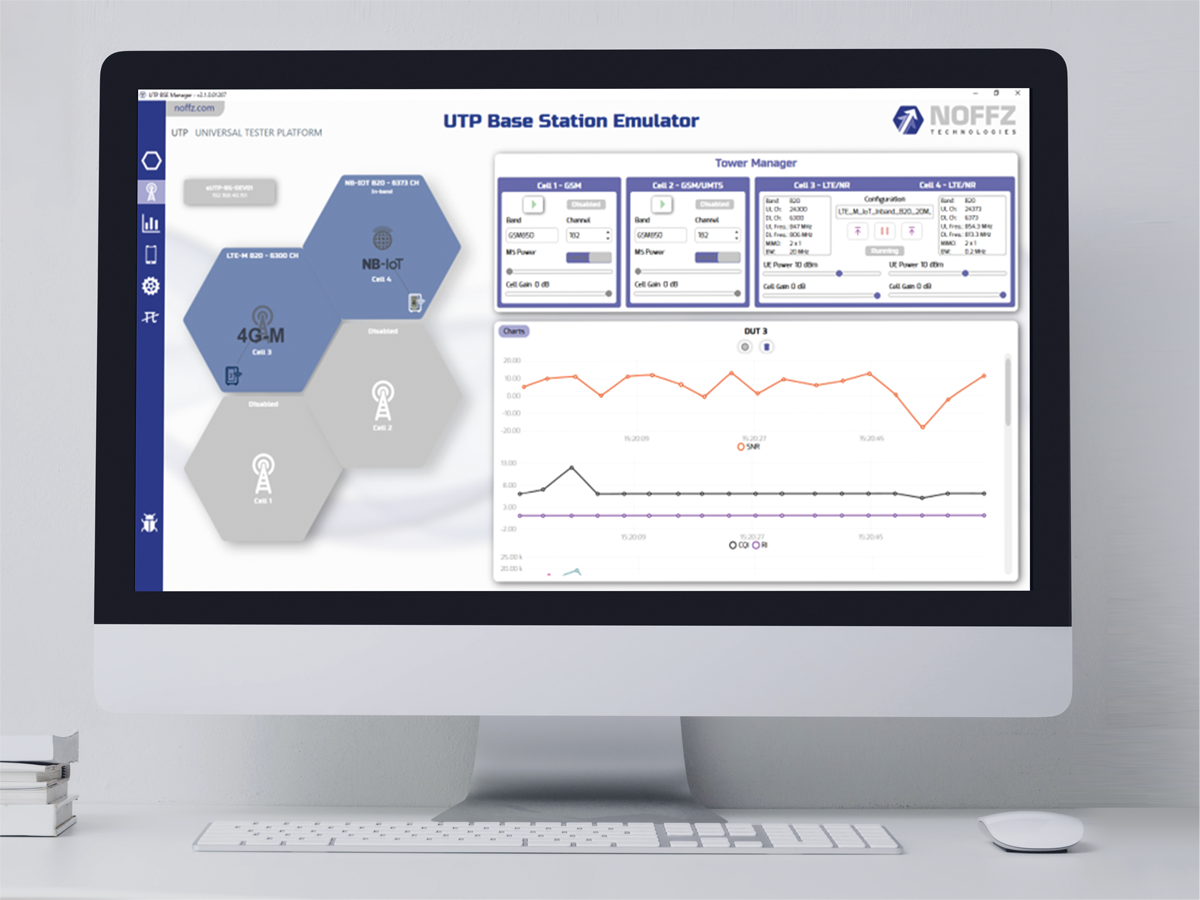
Run the same scenarios continuously for days across up to 32 devices at once, while the BSE Manager monitors each connection: SNR, bit error rate, transmit power, RSSI and logical-channel status. This is how intermittent, long-run failures get caught before the field does.
Features and Specifications
| Specification | BSE X | sUTP 5018 |
|---|---|---|
| Model | sUTP 5014 | sUTP 5018 |
| Architecture | Software-based mobile network emulator on SDR hardware | |
| Cellular technologies | 2G (GSM), 3G (WCDMA Rel 99), 4G (LTE), 5G (NR) | |
| 5G modes | Standalone (SA) and non-standalone (NSA) | |
| Network configurations | Standalone, non-standalone, Dual-MME / Dual-MNO | |
| 3GPP release level | Release 19 | Release 17 |
| MIMO configuration | Up to 8×8 with MU-MIMO | Up to 4×4 |
| Non-terrestrial networks | IoT NTN and Direct-to-Cell (D2C) included; NR NTN optional | Not available |
| Frequency bands | All sub-6 GHz bands | |
| Independent cells | 4 and extensible | Up to 4 |
| Parallel devices (UEs) | Up to 32 devices under test | |
| IoT / M2M | NB-IoT, LTE-M | |
| Handover | 5G–5GSA, 4G–5GSA, 4G–4G, 2G–2G | |
| Test functions | Voice calls, SMS, eCall, NG eCall, data throughput, VoIP, Wi-Fi hotspot, connected gateway | |
| Reported metrics (4G/5G) | Channel quality, rank indicator, UE power, data throughput, NG eCall MSD, MCS index, BLER, SNR, VoIP call parameters, and more | |
| Reported metrics (2G/3G) | MS power, SNR, RSSI, BER, eCall MSD, active channels, CS voice call parameters | |
| Control / Automation | Web UI and REST API for test automation — runs on any client device (PC, tablet, phone); no software installation required, platform independent | BSE Manager as Windows-based control software; automation through .NET remote API. Installaiton required. |
| Integration | Integrates into /en/test-automation-systems/universal-tester-platform/test-rack-utp-7033-rf-for-validation/UTP 7033 Rack, GNSS / Wi-Fi / Bluetooth® / V2X, C-V2X | |
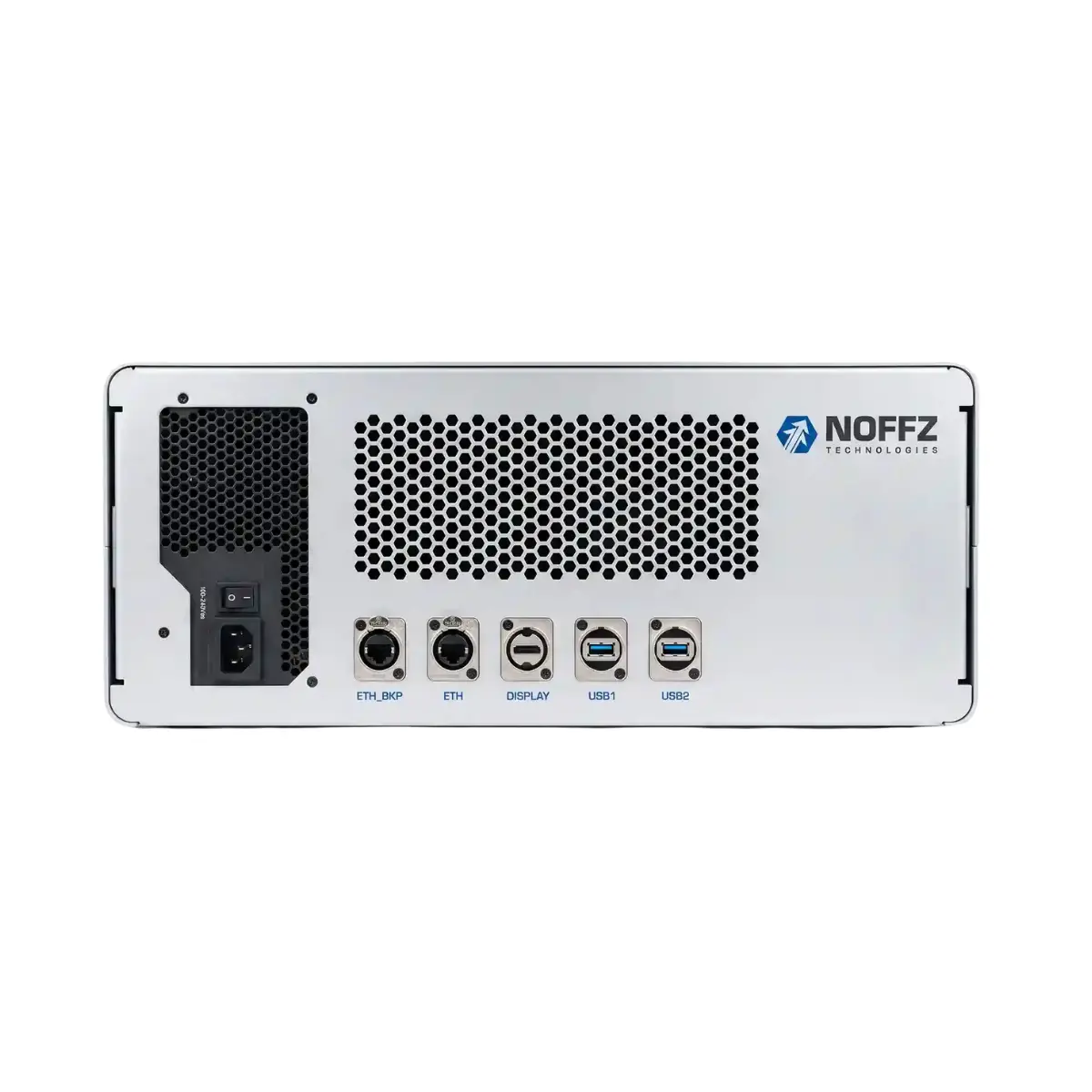
| Dimensions | W 480 × H 177 × D 500 mm | W 505 × H 480 × D 630 mm |
| Weight | 20 kg | 25 kg |
| Applications | Validation and production; multi-day endurance testing, always-on service | |
Non-terrestrial network (NTN) testing
The BSE emulates non-terrestrial networks alongside terrestrial ones, so devices with satellite connectivity can be validated in the lab. IoT NTN (upto Rel 19) for satellite IoT modems and Direct-to-Cell (D2C) — satellite connectivity for standard, pre-Rel 17 cellular devices, also called direct-to-device or satellite-to-phone — are included as standard over LEO, MEO or GEO links.
NR NTN is available as an option as of Rel 18. Because you cannot regression-test against a live satellite constellation, lab emulation is the only way to run NTN scenarios reproducibly — the same pass, the same conditions, every time.
Signaling vs non-signaling testing
| Aspect | Signaling test | Non-signaling test |
|---|---|---|
| What happens | Device fully attaches to an emulated live network | RF measured directly, no full network attach |
| Best for | Functional & protocol validation: calls, data, handover, eCall | Fast RF parametric checks, high-volume production |
| Speed | Slower, realistic | Very fast |
| Coverage | 2G–5G, SA/NSA, IoT (NB-IoT/LTE-M), NTN | RF bands / parametric |
| NOFFZ Product | NOFFZ Base Station Emulator (BSE) | Universal Wireless Tester |
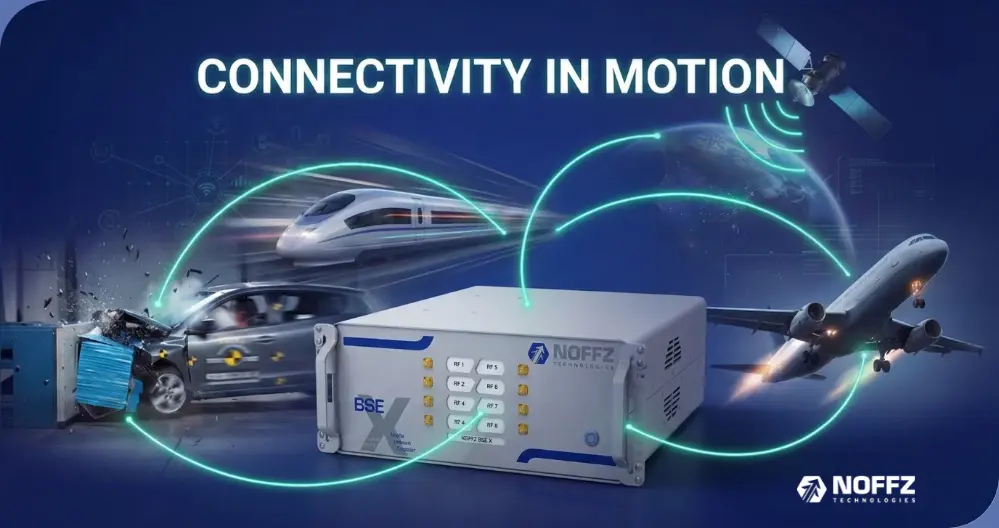
IN ACTION
Testing Connectivity
Beyond Limits
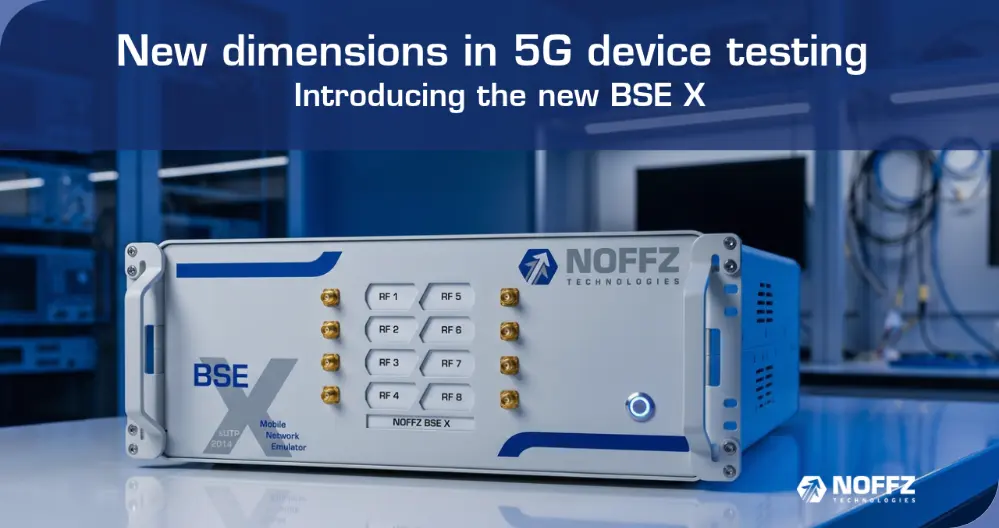
IN ACTION
New dimensions in 5G device testing – Introducing the new BSE X
Test just like in the real mobile network
Web UI and REST API for Test Automation
dual 2×2 or 4×4 MIMO
eNB / gNB
eNB / gNB
SISO
SISO
BTS
BTS
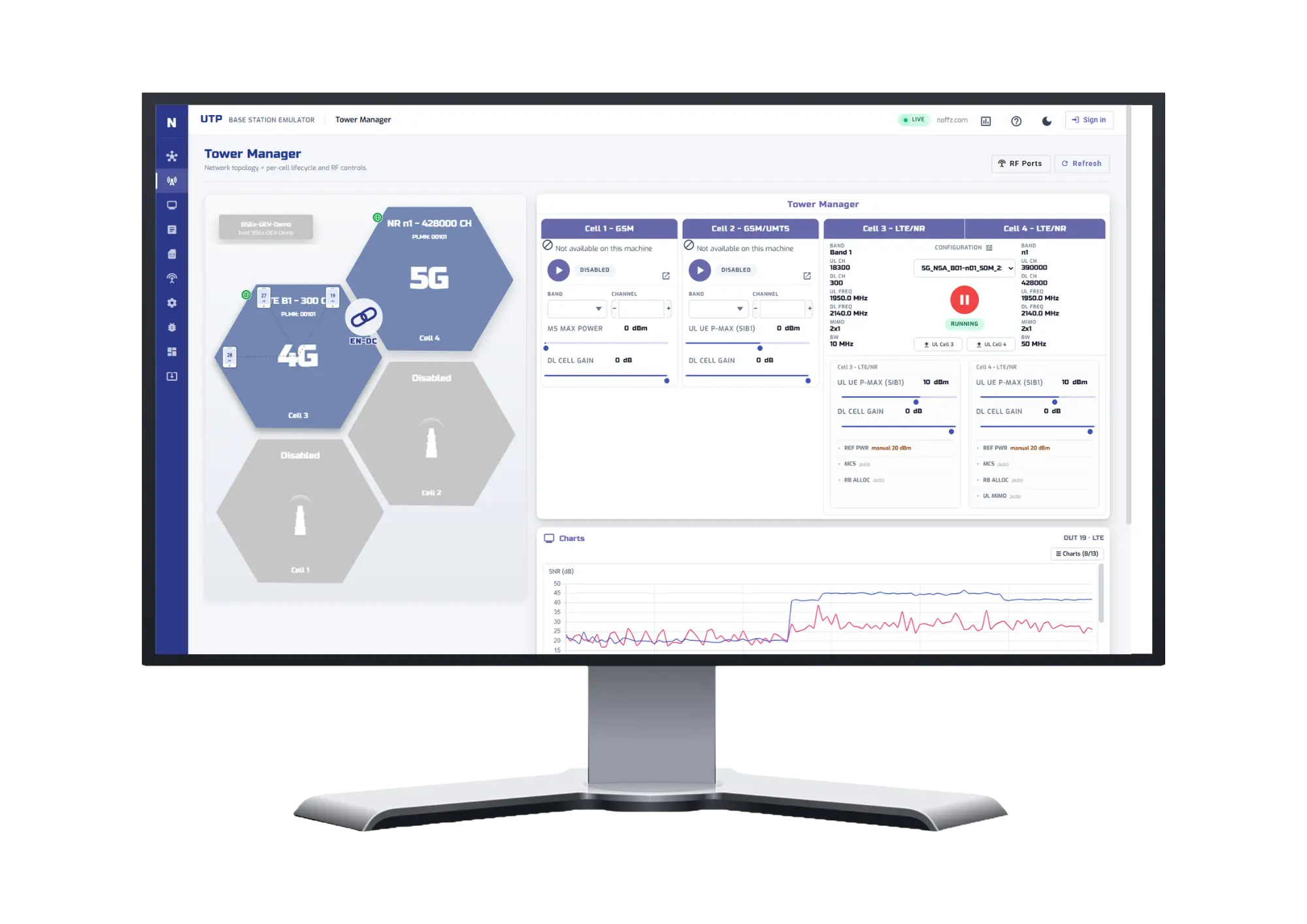
INTERACTIVE CONFIGURATION AND SIMULATION
Software for the Base Station Emulator
Configure various technologies, monitor UEs in a realistic, emulated mobile network
Für NB-IoT- und LTE-M-Zellen registrierte M2M-UEs
Frequently Asked Questions (FAQ)
How is the NOFFZ BSE different from a traditional callbox?
The NOFFZ BSE is a software-based mobile network emulator on SDR hardware, designed from the ground up for parallel multi-DUT testing. Because the network stack runs in software, one unit covers 2G through 5G and non-terrestrial networks. Combining the SDR hardware with the software-based approach results in a functional test tool for mobile devices at a fraction of the costs compared to traditional instruments.
Which cellular technologies does the BSE support?
It emulates 2G (GSM), 3G (WCDMA Release 99), 4G/LTE and 5G networks, including 5G standalone (SA) and non-standalone (NSA) modes, plus Dual-MME / Dual-MNO configurations. It also supports NB-IoT and LTE-M for M2M and IoT devices.
Can the BSE simulate non-terrestrial networks (NTN)?
Yes. IoT NTN and Direct-to-Cell (D2C) — satellite connectivity for standard cellular devices, also called direct-to-device or satellite-to-phone — are included as standard, and NR NTN is available as an option. Devices with satellite connectivity — satellite IoT modems, smartphones and telematics units with satellite fallback — can be validated in the lab under reproducible conditions.
What is NTN testing?
NTN (non-terrestrial network) testing validates a device’s satellite connectivity — its behaviour when connecting through satellite-based cells instead of terrestrial base stations. Because a live satellite constellation cannot be used for controlled, repeatable tests, NTN scenarios are emulated in the lab, where signal conditions, delays and handovers can be reproduced exactly.
How many devices can it test at the same time?
A single BSE can run up to 4 independent cells and connect up to 32 cellular modules (UEs) in parallel, so you can validate many telematics units or IoT modems simultaneously instead of one at a time.
What is the difference between signaling and non-signaling testing?
In signaling testing, the device fully attaches to an emulated live network and you exercise real functions such as calls, data, handover and eCall. In non-signaling testing, the RF is measured directly without a full network attach, which is faster and common in production. The BSE is built for signaling tests; for non-signaling RF production test, NOFFZ offers the Universal Wireless Tester.
Can it test eCall and Next Generation eCall (NG eCall)?
Yes. The BSE supports emergency-call testing including reception and verification of the Minimum Set of Data (MSD) — for legacy eCall over 2G/3G circuit-switched calls and NG eCall over 4G/5G.
Does it support handover testing?
Yes. It can simulate intra-RAT handovers and handovers between 5G standalone, 4G and 2G cells, plus inter-RAT handovers between 4G and 5G cells, so a device can be moved between neighbouring cells exactly as it would be on a real network.
Do I need a live carrier network or a commercial SIM?
No live carrier network or carrier subscription is required. The BSE creates a private, self-contained cellular network in your lab or production line; the devices under test use test SIM or eSIM provisioned for the emulated network, giving you full control of signal conditions and complete reproducibility.
Can it be automated and integrated into a larger test system?
Yes. It provides a web UI for interactive use and a REST API for test automation, and can be integrated into NOFFZ test systems such as the UTP 7033 validation rack, up to a full infotainment validation setup with GNSS, V2X, Wi-Fi, Bluetooth and broadcast radio.
What devices is it typically used to test?
Telematics control units (TCUs), V2X communication modules, smartphones, IoT/M2M modems and the cellular interfaces in e-charging stations — common in automotive, infotainment/telematics, e-mobility, telecommunications, smart-city, IoT and healthcare applications.
It is also used as an educational tool in the Aerospace and Defense sectors.
IN ACTION
First steps with the Base Station Emulator


IN ACTION
NOFFZ UTP 9085
Rotary table/indexing machine for EOL tests in automotive electronics
Introducing our latest automation solution: the UTP 9085 rotary and indexing machine. This state-of-the-art technology offers a comprehensive range of functions: rotary table and robot integration, multi-stage end-of-line inspection with double unit under test (DUT), optical pin inspection, label printing and application.

IN ACTION
NOFFZ UTP 9085
High-Volume Test Automation for Nidec
Exemplary Configuration
Seamless Integration into UTP 7033: Test Rack for Automotive Components
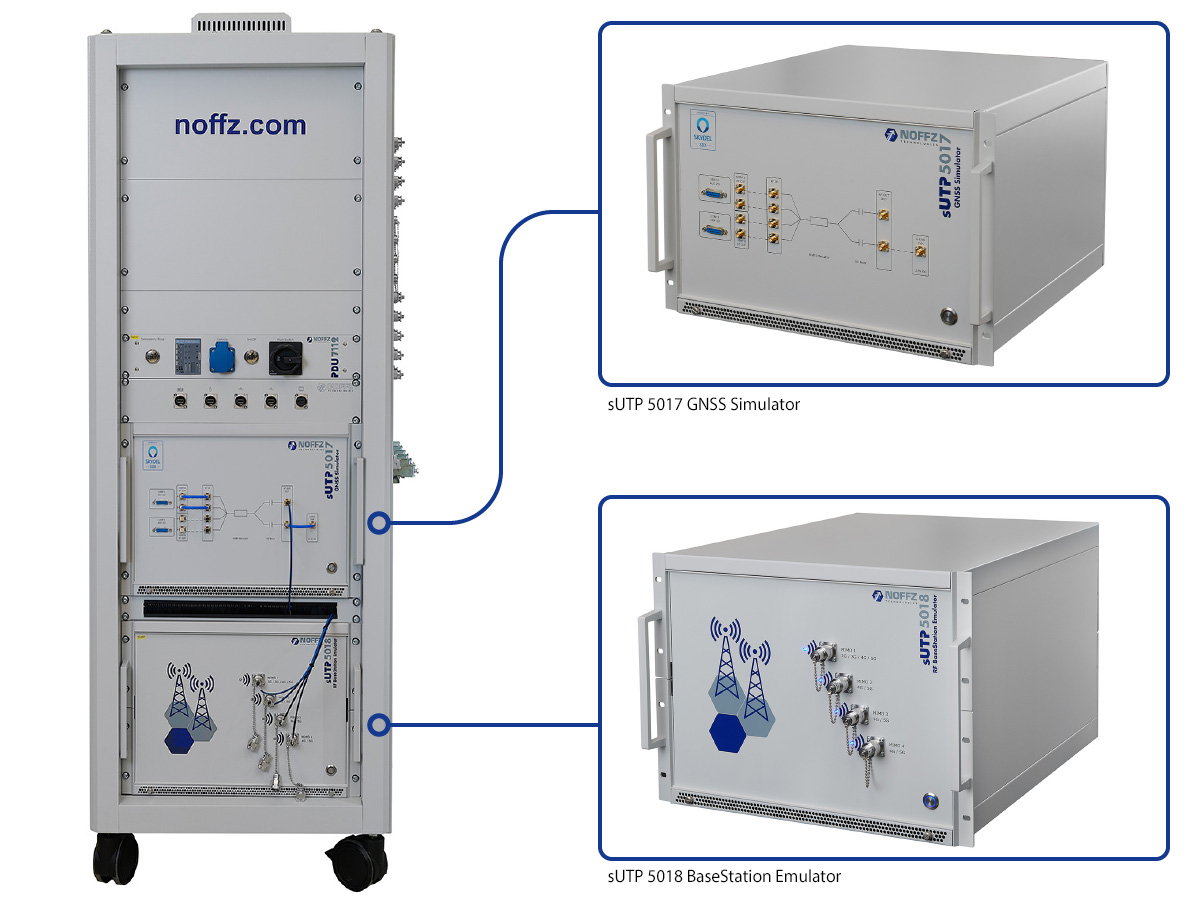
Equipping the sUTP 7033 validation test rack for testing automotive components

Downloads
Our brochures for download
DO YOU HAVE ANY QUESTIONS?
Speak with our experts directly!
Let us know the details of your project. We’re curious about your ideas, products, and requirements and would be glad to advise you specifically about your requests.
Together we’ll make your project a success!
Let’s set up a meeting.
Ales Zitek
Sales Manager Eastern Europe NOFFZ Technologies Hungary Kft.

Automotive devices must be reliable.
Combine all products and
measuring instruments in just one rack for validation.
Test devices with high channel counts in parallel.
Modify satellite trajectories. Simulate environments.
Generate a variety of realistic multiband GNSS signals. Define your parameters individually and test them with high precision. Directly in the lab and in real time.
Efficiently test wireless communication devices with a system designed for high-volume parallel testing. It integrates multiple wireless standards into one platform, allowing you to use up to 64 ports simultaneously.

Larger displays and increasing connectivity.
Improved technologies are setting a rapid pace.
These innovations require intelligent test systems.
We create your individual solution with high precision.