



GNSS
GNSS Simulation in Aerospace and Defense:
Reproducible Testing for Safe Navigation Systems
Reproducible GNSS Scenarios for Development and Validation
Positioning, navigation, and timing synchronization form the foundation of countless modern applications.
From flight management systems and drones to communication networks, many applications rely on precise positioning and timing signals. If these signals are disrupted or lost, the consequences can be significant. That is exactly why such scenarios must be tested under realistic conditions.
Aviation authorities and operators have reported sharp increases in GNSS interference and spoofing across parts of Europe and the Middle East, and civil aircraft now routinely encounter conditions once treated as exceptional. For manufacturers in aerospace, defense and government markets the question has shifted. It is no longer whether a receiver acquires a fix under clear sky. It is how the whole system behaves when the signal is degraded, delayed, contradicted or absent — and whether that behaviour can be demonstrated on demand.

Reproducible GNSS Scenarios for Development and Validation
Field tests alone are not sufficient. Operating a prototype under real-world conditions until a failure recurs is not a reproducible testing method. Interference cannot be planned because the environment is never exactly the same, making it difficult to reliably verify a previously observed failure. For development and validation, one factor is therefore essential: a scenario that can be reproduced at any time.
This is precisely where GNSS simulation comes into play. Instead of relying on real satellite signals, the test solution generates the required navigation signals and feeds them directly into the receiver under controlled conditions. A scenario that reveals a failure today can be repeated under identical conditions after a firmware update, or even years later when hardware or components change.
Requirements for a Modern GNSS Test Solution
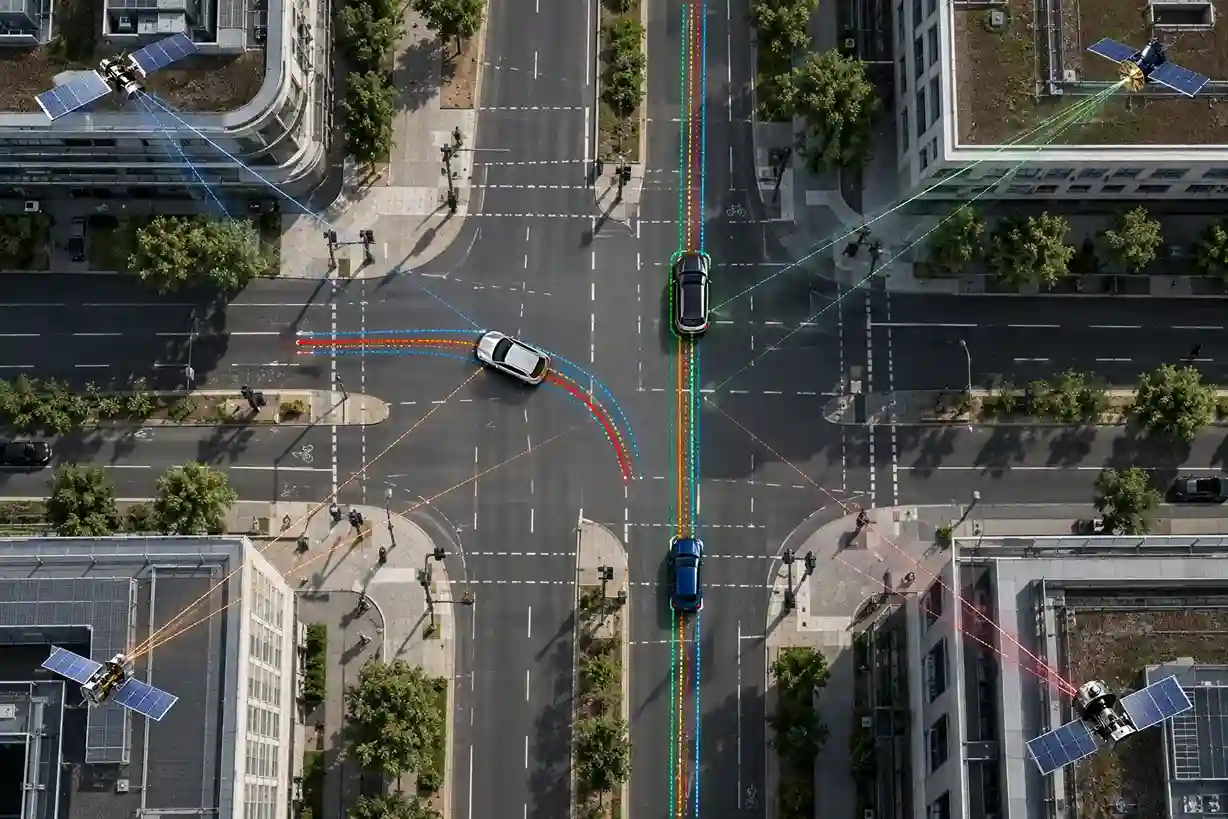
Ein belastbarer GNSS-Testaufbau umfasst deutlich mehr als die Simulation eines einzelnen GPS-Signals. This typically includes:
- Multiband signals from the major constellations, including GPS, GLONASS, Galileo, and BeiDou instead of simulating only a single constellation.
- Augmentation and correction services such as SBAS and RTK, as well as differential GNSS.
- Multi-vehicle simulation, modification of satellite orbits, additive pseudorange ramps, and fixed user-defined positions.
- Targeted injection of interference and jamming signals for security and robustness assessment.
- Free definition of trajectories with up to six degrees of freedom, enabling the simulation of orientation and dynamics rather than just a ground track.
- Update rates of up to 1,000 Hz, enabling realistic simulation of rapid platform dynamics.
The values provided are intended as general guidance only. The optimal configuration always depends on the specific application. While a ground vehicle can often operate with lower dynamics and update-rate requirements, highly dynamic aerospace or defense applications require significantly more powerful simulation scenarios.
Key Criteria in Practical Testing
In addition to technical performance specifications, practical usability is the key factor determining whether a GNSS simulator can be successfully integrated into development and testing processes.
A key requirement is seamless integration into existing test environments. Only when the simulation can be incorporated into hardware-in-the-loop systems and existing cellular, Wi-Fi, or RF test setups can the receiver be validated under realistic system conditions.
Automation is equally important. By integrating the simulator with test frameworks and controlling it via LabVIEW or open interfaces for Python, C#, and C++, it becomes an integral part of automated test workflows. This enables GNSS tests to be performed reproducibly and incorporated into continuous development and validation processes.
In addition, the solution should support the processing of real-world driving or flight data. Importing trajectories from NMEA, KML, or CSV files makes it possible to repeat recorded missions under identical conditions as often as required. This turns real-world operational scenarios into reproducible regression tests that enable reliable verification of software changes, hardware modifications, and system updates.
Why GNSS Simulation Is Essential for Aerospace, Defense, and Government Projects
In aviation, defense, and government applications, requirements are significantly more stringent than in the consumer sector. Test and validation results must remain traceable, reproducible, and well documented, even years later. At the same time, GNSS scenarios are often combined with other test conditions, for example in environmental chambers, hardware-in-the-loop environments, or vibration and shock tests. It must therefore be ensured that all tests can be repeated under identical conditions.
In addition, development and qualification programs often span many years and multiple product generations. Test systems must therefore be flexible, expandable, maintainable, and available over the long term. At the same time, validation under disrupted or restricted GNSS conditions is becoming increasingly important. The ability of a system to operate reliably despite signal loss, spoofing, or other interference is increasingly becoming a standard development requirement.
NOFFZ develops test and automation solutions specifically for these challenges. With more than 35 years of experience in RF and wireless test integration, its modular Universal Tester Platform (UTP), in-house development and manufacturing in Europe, and ISO 9001 and CSIA certifications, NOFFZ supports customers in implementing complex test systems.
As a leading system integrator specializing in RF and wireless applications, NOFFZ does not view GNSS simulation as an isolated solution, but rather as an integral part of a comprehensive test environment. In practice, a system’s performance is never determined by a single signal alone, but by the interaction of all relevant influencing factors.
GNSS Test Solutions Tailored to Your Application
Whether for a development workstation, a qualification environment, or an automated end-of-line test solution with full traceability, NOFFZ develops and integrates GNSS test systems tailored precisely to the requirements of each platform and application. By combining GNSS simulation, RF test technology, automation, and system integration, NOFFZ creates scalable solutions for development, validation, and production.
→ Luftfahrt, Raumfahrt & Verteidigung
→ HF-Tests
→ Individuelle Lösung anfragen