
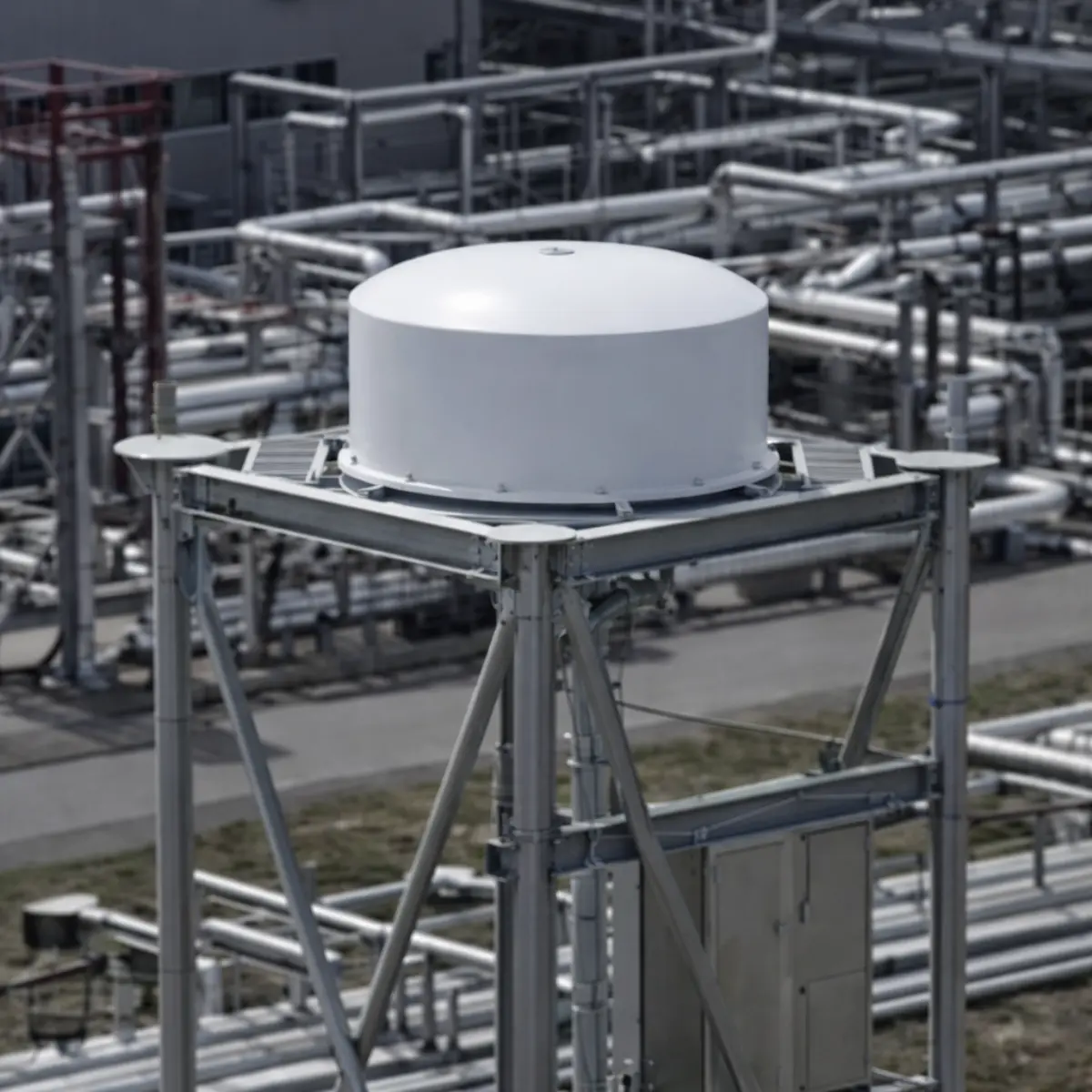
NORD is not a fixed, one-size-fits-all product. The antenna subsystem and RF front end are configured per deployment, so detection range, directional accuracy and frequency selectivity are matched to the site and the threat picture rather than to a datasheet.

What NORD does
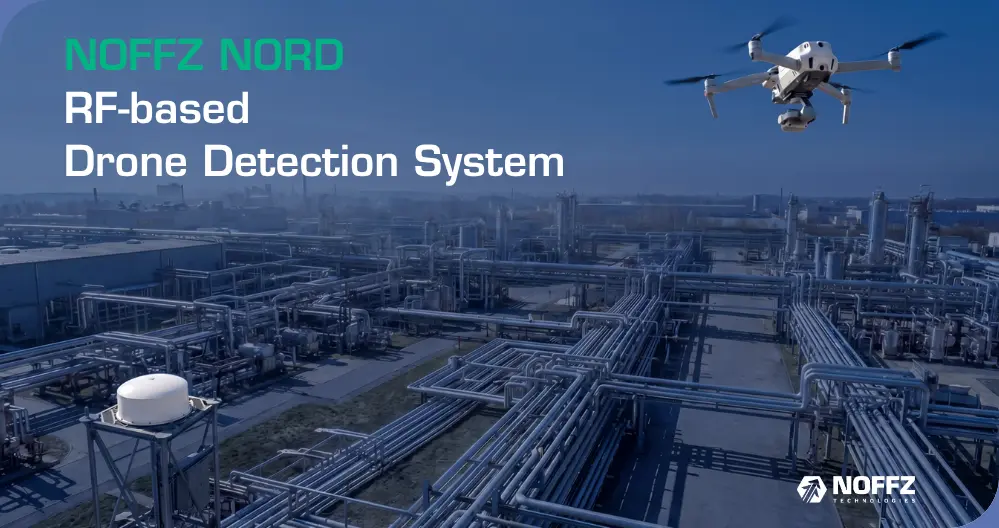
Detects – Locates – Identifies
Detects. NORD monitors 70 MHz to 6 GHz continuously and identifies drone communication links within that spectrum, separating them from the other RF activity present at any real site.
Locates. For every detected link the system determines direction of arrival, operating frequency, bandwidth and signal power. Sector antennas with fast RF switching scan the full 360° azimuth and 90° elevation in under two seconds.
Identifies. NORD decodes commercial drone protocols in real time, returning the Drone ID, the drone’s GPS position, the pilot’s GPS position and the home-point GPS position — so operators see the operator on the ground, not only the aircraft in the air.
How RF-based drone detection works
Every commercial drone maintains a radio link with its controller. RF-based detection works by listening to that link, rather than by illuminating the aircraft with a transmitted signal as radar does.
A wideband receiver monitors the spectrum continuously. When a transmission matching a known drone communication signature appears, the system measures its direction of arrival, frequency, bandwidth and power, then decodes the protocol carried within it.
Because the method is passive, it emits nothing, requires no frequency allocation, and works regardless of the aircraft’s size or radar cross-section. The limiting factor is whether the drone is transmitting, not how small it is.
Radar-based detection is complementary rather than competing: radar sees fully autonomous aircraft flying without an active control link, which RF sensing cannot. Most serious installations combine the two, with optical confirmation as a third layer. NORD is built to sit inside that kind of layered architecture.
Technical Data
| Parameter | Value |
|---|---|
| Frequency range | 70MHz – 6GHz |
| Detection range | Up to 5 km, configuration dependent |
| Spatial coverage | 360° azimuth, 90° elevation |
| Scan time | Full spatial scan in under 2 seconds |
| Antenna subsystem | Sector antennas with fast RF switching; geometry and gain configured per deployment |
| Channelizer output | Sector, operating frequency, bandwidth, signal power |
| Protocol decoding | Real-time DJI protocol decoding: Drone ID, Drone GPS, Pilot GPS, Home GPS |
| Receive architecture | Independent receiving chains for simplified maintenance |
| Hardware platform | NI USRP software-defined radio with FPGA-based signal processing |
| Deployment | Indoor and outdoor; ruggedisation level selected per operating environment |
| System integration | Jammers, optical surveillance systems, central control units |


Real-time protocol decoding
Detection tells you something is flying. Decoding tells you what it is and where its operator is standing.
NORD performs real-time decoding of commercial drone communication protocols. For DJI aircraft it extracts four fields that matter operationally:
- Drone ID — the unique identifier of the aircraft, allowing repeat incursions by the same airframe to be linked
- Drone GPS — the live position of the aircraft
- Pilot GPS — the live position of the operator on the ground
- Home GPS — the programmed return-to-home point, which is usually where the flight started
The pilot and home-point positions are the operationally decisive ones. They turn a detection event into something a security team can act on, because the response can be directed at a person at a known location rather than at an aircraft moving through controlled airspace.
Configurations
Full-coverage sector array — up to 5 km
The flagship configuration uses a static array of sector antennas with fast RF switching, covering 360° of azimuth and 90° of elevation with a complete scan cycle under two seconds. Independent receiving chains keep the system serviceable without taking the whole installation offline. This is the configuration for permanent installations protecting critical infrastructure, where continuous coverage and maximum range matter more than portability.
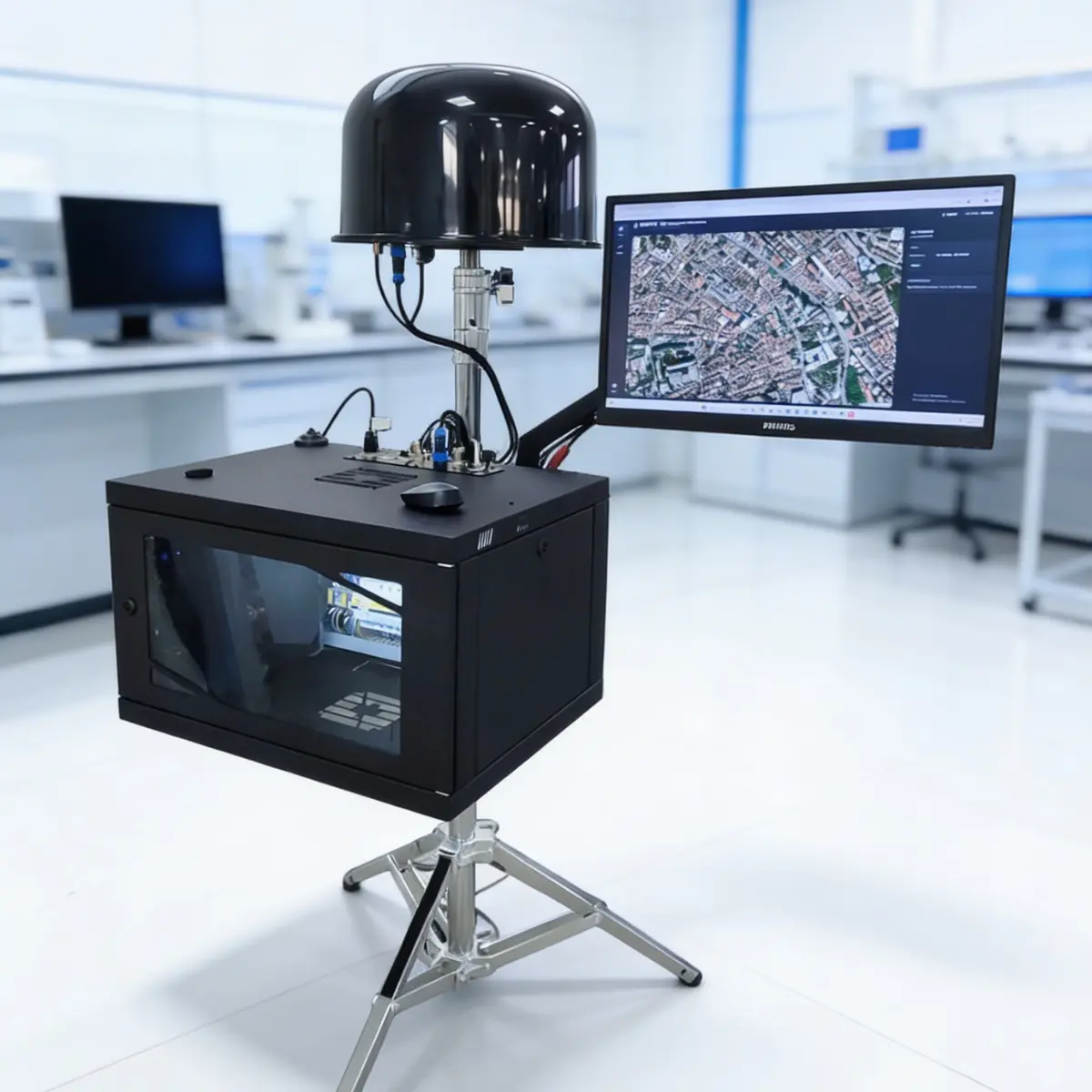
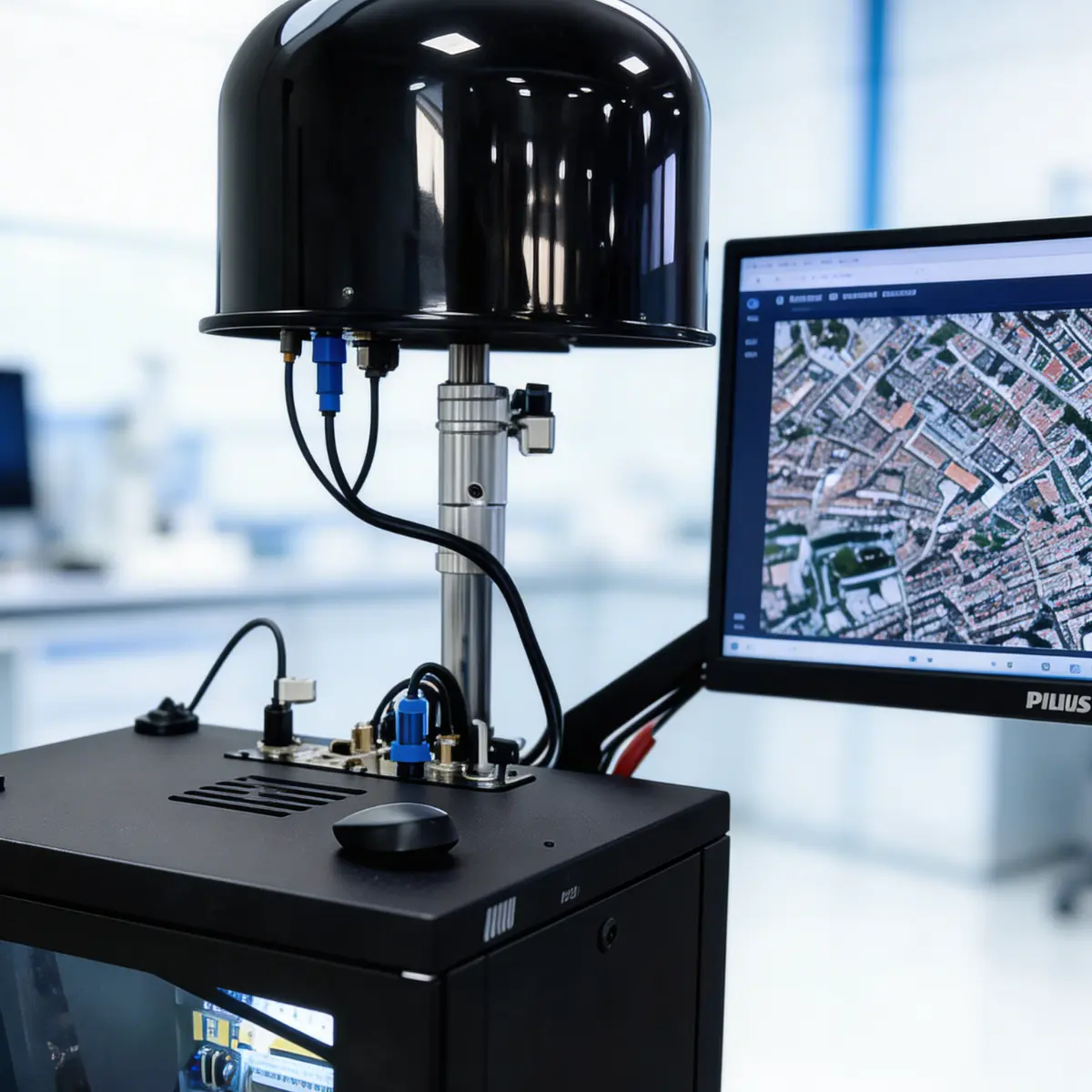
Single rotating directional antenna — up to 2 km
What gets customised
The core concept of NORD is configuration to the deployment, not selection from a catalogue. The following are specified per project:
• Antenna subsystem — geometry, gain and switching arrangement
• RF front-end architecture — sensitivity, selectivity and band coverage
• The trade-off between detection range and directional accuracy
• Frequency selectivity, where the local spectrum environment is congested
• Ruggedisation level, matched to the operating environment
• Integration interfaces to existing jammers, sensors and control systems
• Signal processing software, including customer-specific processing requirements
Integration into counter-UAS systems
NORD is designed as a sensor inside a wider counter-UAS architecture rather than as a closed system. It integrates with:
- Jammers and other effectors, handing over target and bearing data
- Optical surveillance systems, for visual confirmation and classification
- Central control units and command-and-control software, as an RF sensor feed
That openness is a deliberate design decision. Sites that already operate a counter-UAS capability rarely need a second complete system; they need a better RF sensing layer feeding what they already have.
Applications
- Protection of critical infrastructure — energy, utilities, transport and industrial sites
- Protection of sensitive locations against commercial drone incursions
- Airspace situational awareness for security and site operations teams
- RF sensing layer within larger counter-UAS installations
- Electronic warfare research, spectrum surveillance and high-performance RF monitoring
Why NOFFZ
- Software-defined radio and FPGA-based signal processing are core competences, not outsourced elements
- Built on commercial off-the-shelf NI USRP hardware, which keeps the upgrade path open and avoids lock-in to proprietary silicon
- Full customisation of antenna subsystem, RF front end and processing software, rather than configuration of a fixed product
- In-house RF hardware design, PCB design and manufacturing, and rack and cable assembly
- An engineering organisation built around RF test and measurement, where measurement accuracy is the product
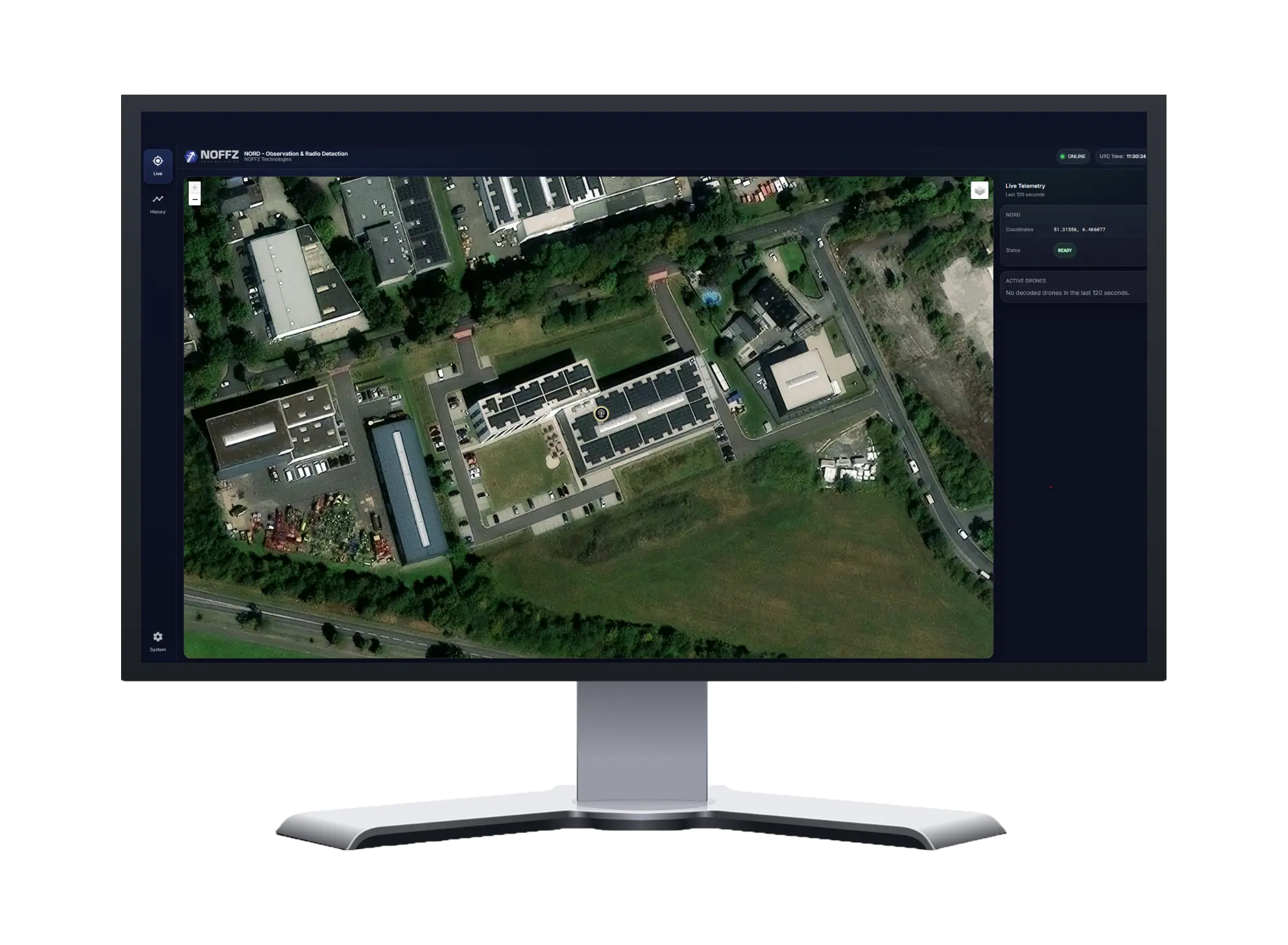
Software User Interface for NORD
Frequently Asked Questions (FAQ)
How does an RF-based drone detection system work?
It listens to the radio link between a drone and its controller. A wideband receiver monitors the spectrum, and when a transmission matching a drone communication signature appears, the system measures its direction of arrival, frequency, bandwidth and signal power, then decodes the protocol. The method is passive, so it emits nothing and works regardless of the aircraft’s size or radar cross-section.What detection range can an RF drone detection system achieve?
NORD detects and decodes commercial drone communication links at ranges up to 5 km in its full sector-array configuration. A compact configuration with a single rotating directional antenna is optimised for ranges up to 2 km. Achievable range depends on the antenna subsystem, the RF front end and the local spectrum environment, which is why NORD is configured per deployment.What is the difference between RF-based and radar-based drone detection?
RF detection passively listens to the drone’s control link; radar actively transmits and measures the reflection. RF sensing identifies the drone and often its operator, works on very small aircraft regardless of radar cross-section, and requires no frequency allocation — but cannot see a fully autonomous drone flying without an active link. Radar can see that drone but cannot identify it. Layered installations use both.Can a drone detection system locate the pilot as well as the drone?
Yes, where the drone’s protocol carries that information. NORD decodes the DJI protocol in real time and extracts the Drone ID, the drone’s GPS position, the pilot’s GPS position and the programmed home point. That allows a security response to be directed at the operator on the ground rather than only at the aircraft.Which drone communication protocols can NORD decode in real time?
NORD performs real-time decoding of commercial DJI drone communication protocols, returning Drone ID, Drone GPS, Pilot GPS and Home GPS. Protocol support is part of the signal processing software and is extended per project where a deployment requires it.Can NORD be integrated into an existing counter-UAS installation?
Yes. NORD is built as an RF sensing layer rather than a closed system, and integrates with jammers and other effectors, optical surveillance systems, and central control units. Sites that already operate a counter-UAS capability typically deploy NORD to improve RF detection and identification within the architecture they have.IN ACTION
See NORD in action

Downloads
Our brochures for download
DO YOU HAVE ANY QUESTIONS?
Speak with our experts directly!
Let us know the details of your project. We’re curious about your ideas, products, and requirements and would be glad to advise you specifically about your requests.
Together we’ll make your project a success!
Let’s set up a meeting.