


Next-Generation Positioning
Real-Time Tracking of Starlink Signals:
Advancing Next-Generation Positioning
Introduction
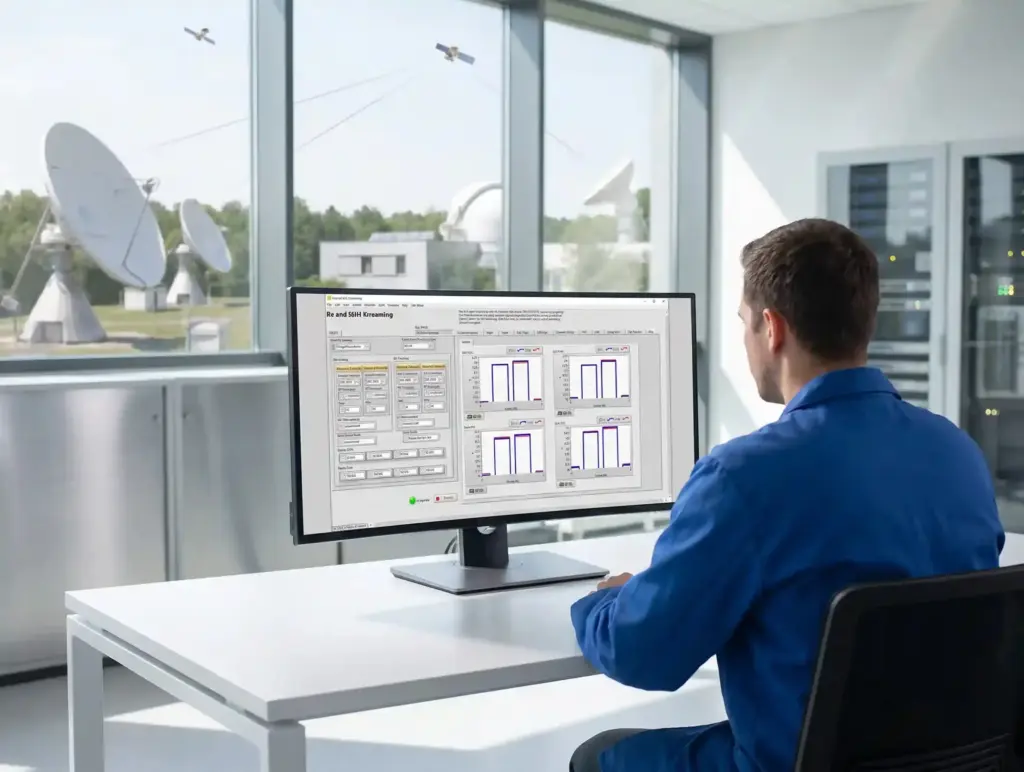
At ENC 2026, a joint research team from the University of the Bundeswehr Munich and NOFFZ Technologies presented a breakthrough in real-time processing of non-terrestrial signals: the tracking of Starlink OFDM signals across multiple channels using a high-performance SDR setup. This work demonstrates how commercial LEO constellations like Starlink can be leveraged as signals of opportunity for positioning, navigation, and timing (PNT) applications.
Pushing the Limits of Real-Time Signal Processing
Tracking Starlink signals in real time introduces several technical challenges, including extremely wide bandwidths, sparse synchronization signals, and high data throughput requirements. To address these challenges, the team implemented a scalable architecture based on the MuSNAT SDR framework, GPU-accelerated correlation, and a high-performance frontend developed by NOFFZ Technologies.
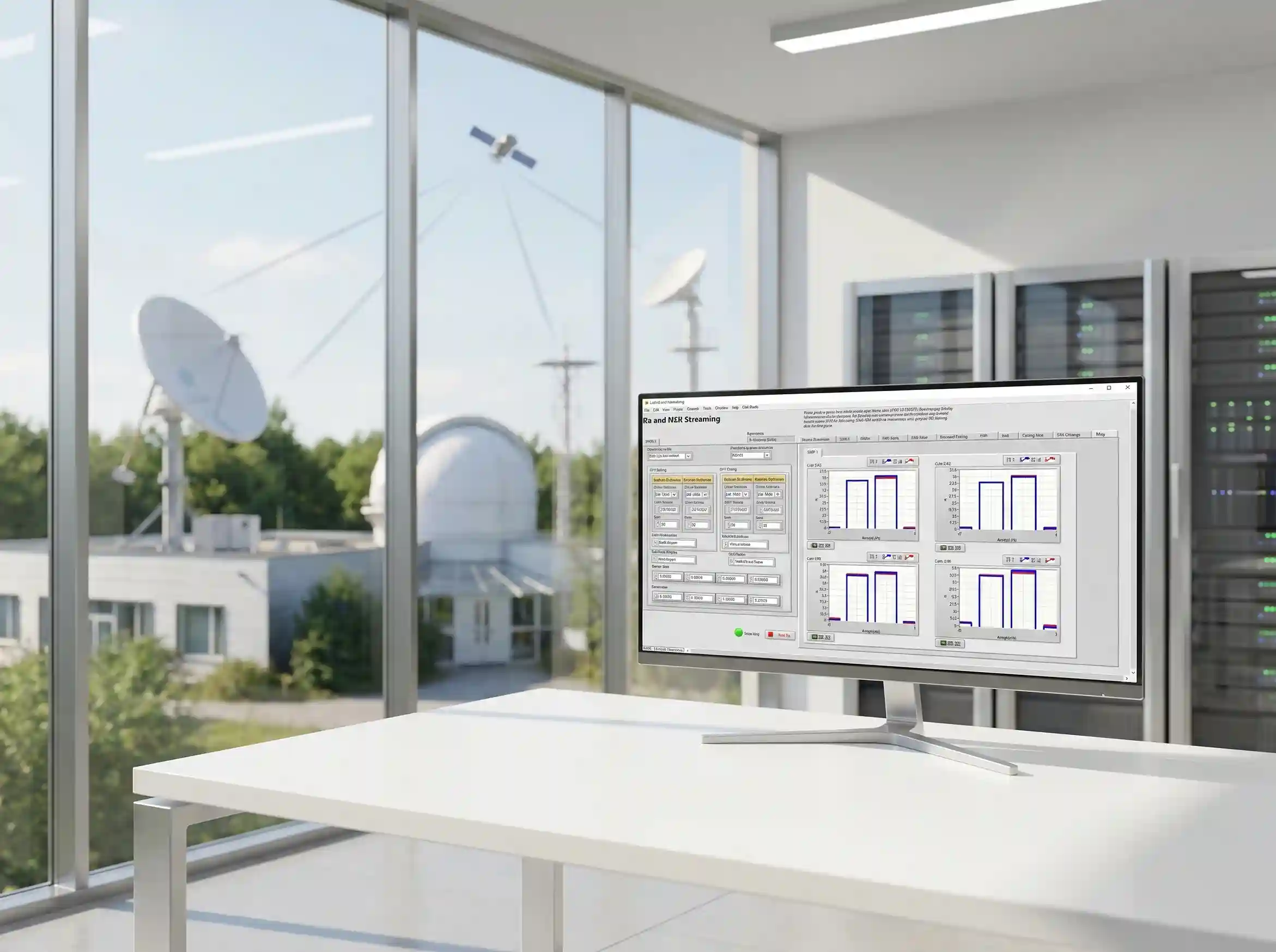
The system is built around a synchronized multi-channel RF architecture using two USRP 2955 devices, enabling up to eight RF channels. A LabVIEW-based frontend developed by NOFFZ ensures flexible signal acquisition, efficient buffering, and reliable high-throughput data streaming.
Real-Time Processing: Performance and Bottlenecks
The analysis showed that real-time SDR processing is primarily memory-bound rather than CPU-bound. GPU acceleration enables efficient signal correlation, but a block-processing discriminator currently represents the main performance bottleneck.
Extended observation runs confirmed stable signal tracking across multiple Starlink channels, with signal quality levels consistently above 40 dB-Hz. This demonstrates reliable operation and validates the overall system design.
Multi-Channel Starlink Observation
In post-processing mode, the system successfully evaluated multiple RF channels simultaneously, detecting active Starlink signals and handling large datasets efficiently. This confirms scalability for advanced testing scenarios.
Future work will focus on optimizing algorithms for full real-time capability, improving long-term stability, and extending support for additional RF channels. The system is also being evaluated as a reference solution for advanced positioning applications.
NOFFZ Contribution
NOFFZ Technologies contributed by developing the LabVIEW-based frontend software and supporting the hardware integration, enabling reliable high-throughput signal acquisition and processing.
Real-time tracking of Starlink signals is now a practical solution for next-generation positioning. This work highlights the potential of combining SDR systems with optimized software to unlock new capabilities in hybrid PNT architectures.
Click below to learn more about our solution: