



NORD
NOFFZ Delivers Flexible RF Drone Detection
with NI USRP for Critical Infrastructure Protection
Modern critical infrastructure environments face a growing threat from unauthorized commercial drones. From oil refineries and energy facilities to government sites and airports, drones can be used for surveillance, disruption, or even targeted attacks. These evolving risks require detection systems that go far beyond traditional approaches – systems that are not only reliable, but also flexible, adaptable, and capable of operating in highly complex RF environments.
To address these challenges, NOFFZ developed the NORD drone detection system – a flexible, RF-based solution designed specifically for high-security aerospace and defense applications. Built on NI’s USRP software-defined radio (SDR) platform, NORD combines high-performance RF hardware with custom-developed signal processing and decoding capabilities from NOFFZ.
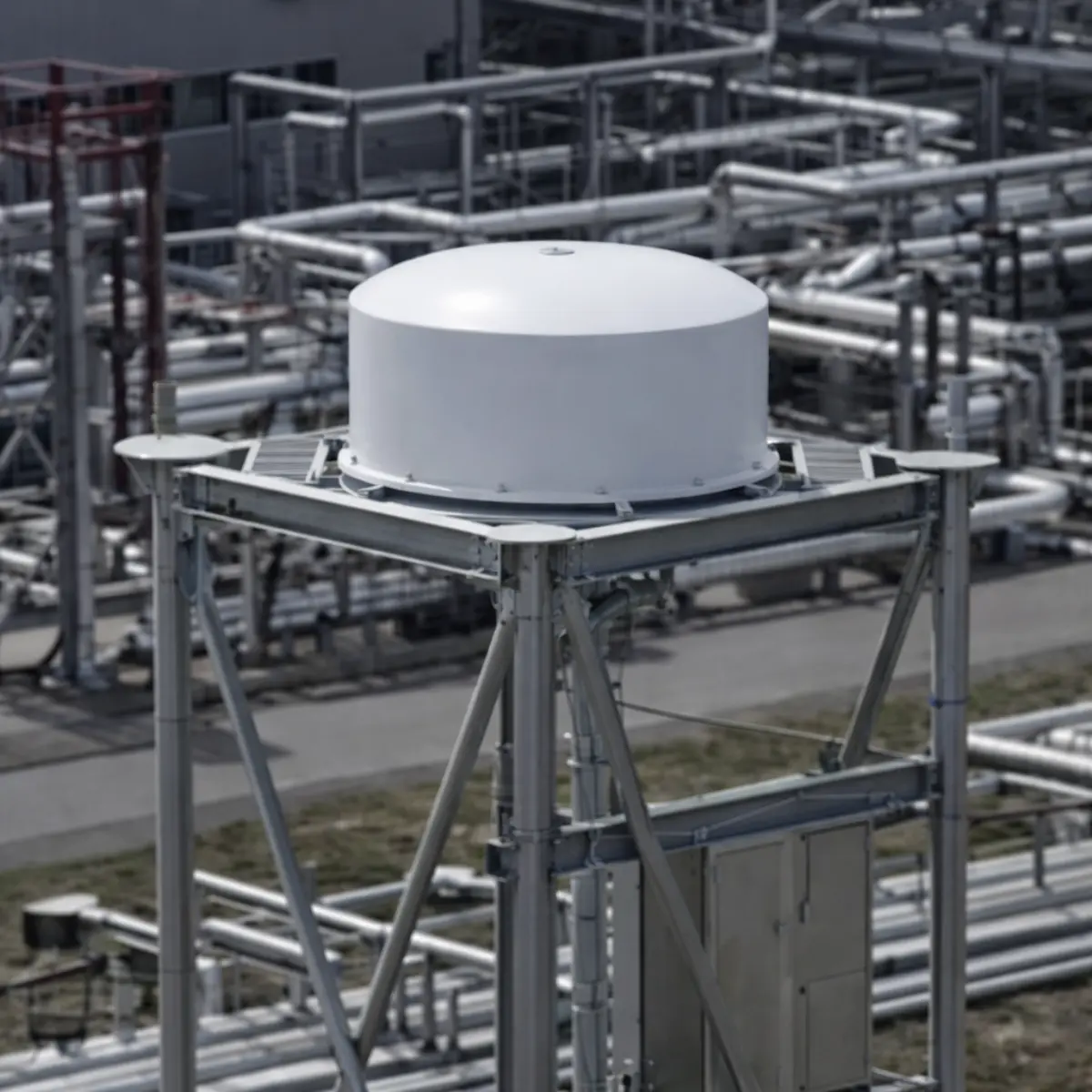
In addition to protecting critical infrastructure, the NORD system is highly relevant for a wide range of aerospace and defense use cases. These include airport perimeter security, where unauthorized drones can disrupt operations and endanger passengers; military bases and restricted zones, which require early warning capabilities; government and intelligence facilities, where preventing surveillance and intrusion is essential; as well as energy and communication infrastructure, where drones pose increasing risks.
At its core, NORD is engineered as a complete RF drone detection system capable of real-time detection, identification, and tracking of commercial drones. Leveraging FPGA-based signal processing, the system performs rapid data analysis with minimal latency, allowing security teams to respond quickly to potential threats. Its wideband frequency coverage—from 70 MHz up to 6 GHz—ensures that it can monitor a broad range of drone communication signals, including modified or proprietary RF transmissions that would typically evade conventional detection systems.
A key capability of the system is its ability to decode drone communication protocols in real time. In particular, NORD includes deep decoding of widely used standards such as DJI protocols. This enables not only the detection of drones, but also the extraction of critical telemetry data such as drone position, pilot location, and communication parameters. This level of insight significantly enhances situational awareness and allows for more informed decision-making in high-risk environments.
To ensure comprehensive coverage, the system uses fast RF scanning in combination with sector antennas, enabling full spatial scanning in under two seconds. This rapid scanning capability is essential for maintaining continuous awareness in dynamic environments, where drone activity can appear and change quickly. At the same time, the system’s SDR architecture allows it to adapt easily to new frequencies, protocols, and operational requirements without the need for major hardware changes.
One of the defining characteristics of NORD is its open and modular system design. The platform is built to integrate seamlessly with existing safety and security infrastructures, as well as with additional counter‑UAS components such as jammers, optical tracking systems, and central command-and-control platforms. This makes it not just a standalone detection solution, but part of a broader, scalable security ecosystem.
The flexibility of the SDR-based approach is particularly important in the context of European defense and industrial requirements. Increasingly, organizations demand systems that are software-defined, customizable, and future-proof. By combining NI’s USRP platform with NOFFZ’s application-specific development, NORD fully supports this paradigm, enabling continuous updates, enhancements, and adaptation to mission-specific needs.
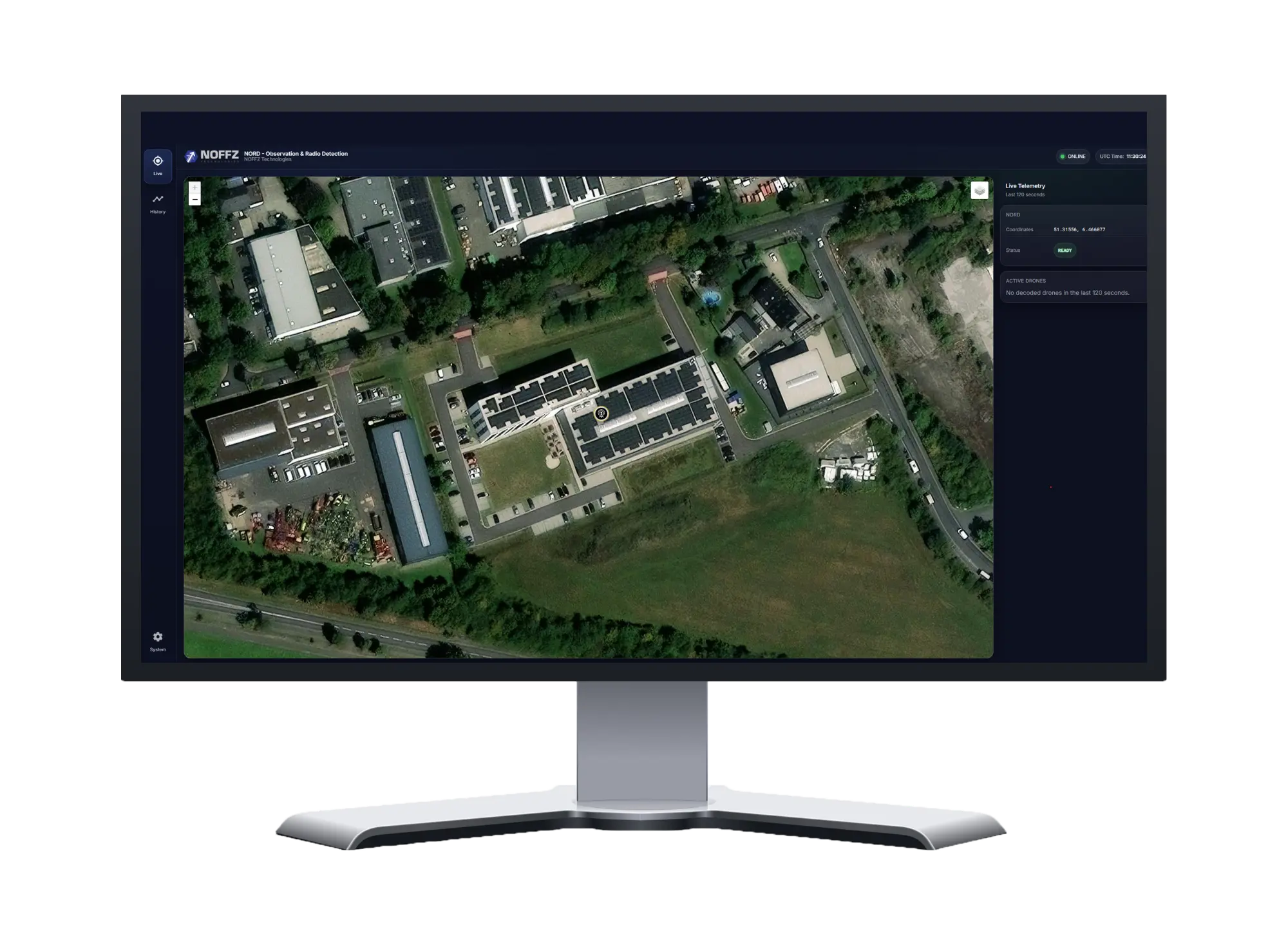
The system also offers flexible deployment options, supporting both indoor and outdoor installations with different levels of ruggedization. This ensures reliable operation across a wide range of environments—from fixed infrastructure installations to more demanding field deployments.
The effectiveness of the NORD system has already been demonstrated in a real-world application. The solution was successfully deployed in an oil refinery complex , where it is used to secure critical infrastructure. In this environment, NORD provides reliable detection and tracking of drone activity, even in the presence of complex RF conditions typical for industrial sites. The deployment highlights the system’s ability to integrate quickly into existing infrastructures while delivering immediate operational value.
As a result, security teams benefit from significantly improved situational awareness, faster response capabilities, and a higher level of confidence in their monitoring systems. At the same time, the project demonstrates how a software-defined, open architecture approach can meet the specific demands of European defense and security stakeholders.
The underlying technology—combining software-defined radio and FPGA-based processing—plays a crucial role in enabling these capabilities. SDR allows for flexible and reconfigurable monitoring across wide frequency ranges, while FPGA hardware accelerates signal processing to achieve ultra-fast detection and identification. Together, these technologies reduce latency, improve performance in congested RF environments, and ensure that the system remains adaptable as new drone technologies emerge.
With NORD, NOFFZ and NI demonstrate how modern drone detection systems must evolve to address current and future threats. The combination of a flexible SDR platform, advanced signal processing, and an open, modular architecture results in a solution that is both powerful and adaptable. It enables organizations to move beyond static detection systems and towards dynamic, software-defined security solutions that can evolve alongside the threat landscape.
Ultimately, NORD represents a next-generation approach to drone detection—one that delivers high performance, scalability, and mission readiness. By leveraging the strengths of NI’s USRP technology and NOFFZ’s development expertise, the system provides a future-proof foundation for protecting critical infrastructure and ensuring operational security in an increasingly complex aerial environment.
About NOFFZ
NOFFZ Technologies ist auf branchenführende Testsysteme und Automatisierungslösungen für Bereiche wie Automotive, Telekommunikation, Consumer Electronics, Luft- und Raumfahrt & Verteidigung sowie Medizintechnik spezialisiert. Die Universal Tester Platform (UTP) bietet flexible und standardisierte Testlösungen.
NOFFZ Technologies specializes in industry-leading test systems and automation solutions across sectors like automotive, telecommunications, consumer electronics, aerospace & defense, and medical industries. Their Universal Tester Platform (UTP) offers flexible and standardized testing solutions. With RF and wireless expertise, NOFFZ excels in complex mixed-signal testing from validation to production. They customize solutions for specific wired and wireless needs, including connectivity, infotainment, ADAS, and EV applications.
Founded in 1989 by Wilfried Noffz, the company employs around 250 people worldwide (Germany, Hungary, Serbia, USA, Mexico, China) and is led by Tobias Noffz and Markus Solbach. Headquartered in Germany, NOFFZ operates globally and holds ISO and CSIA certifications.
→ NORD (NOFFZ Observation and Radio Detection)