


From Prototype to Scalable Series Testing
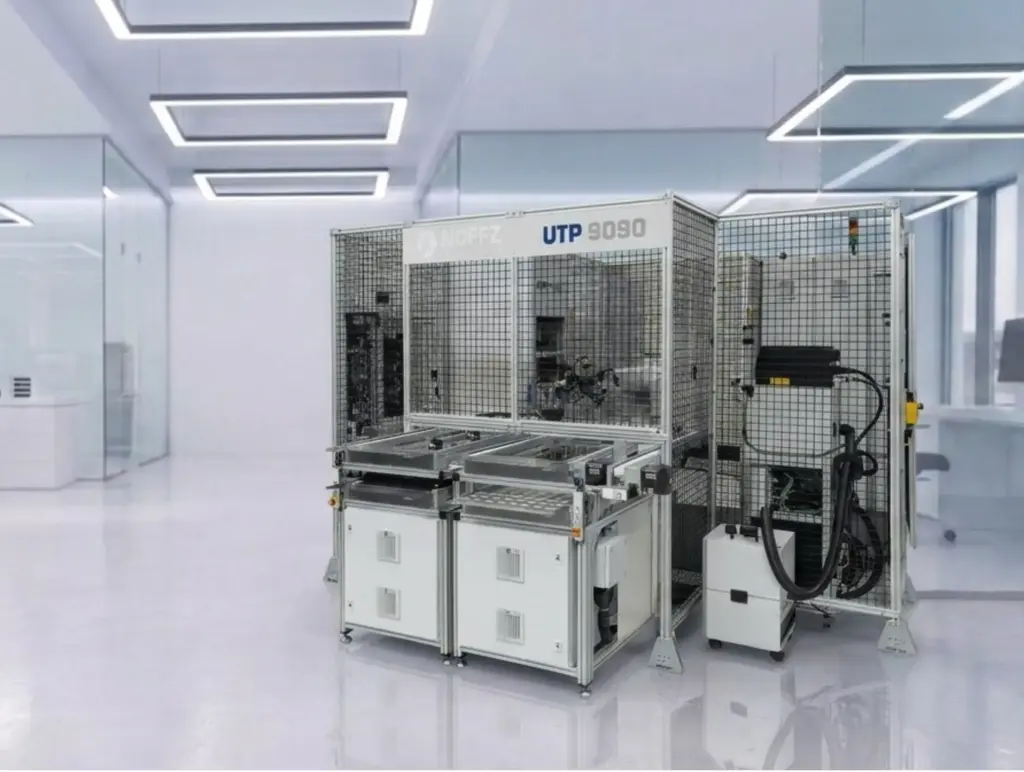
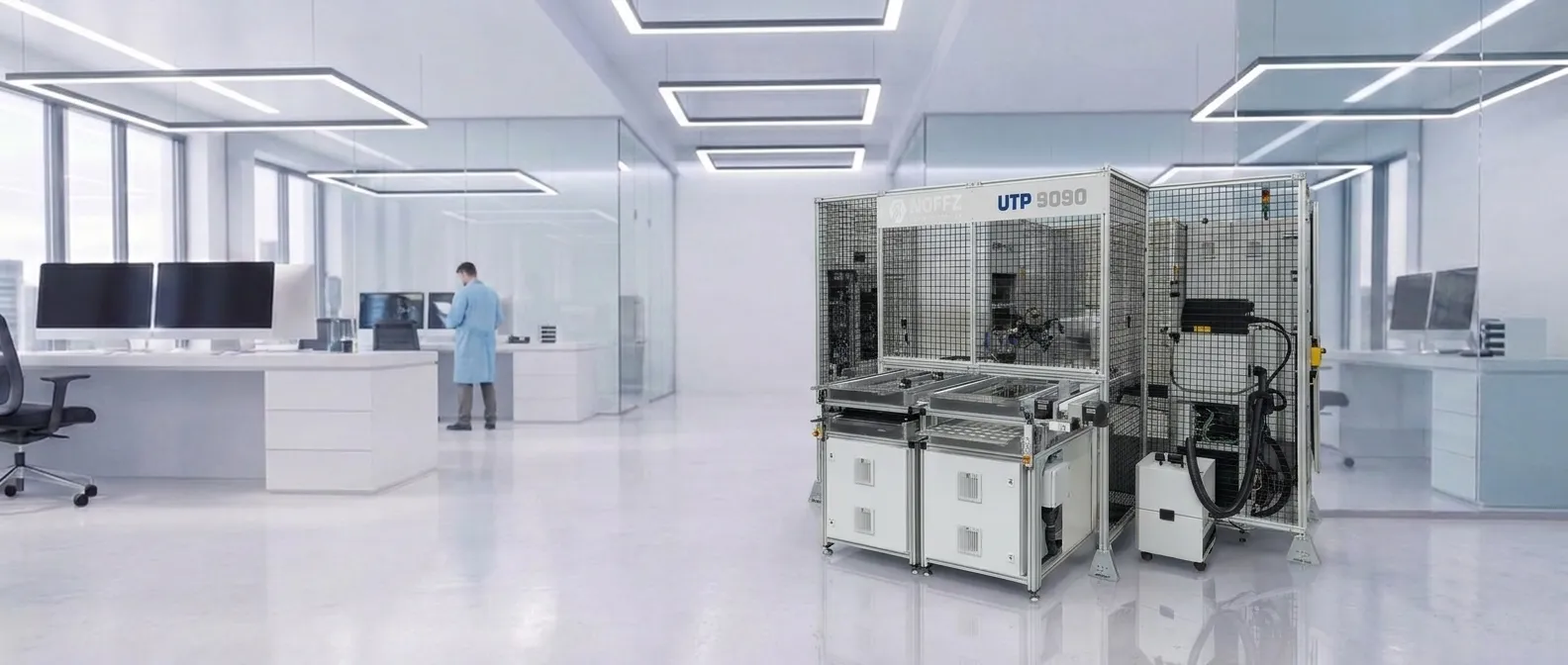
UTP 9090: Fully Automated End-of-Line Test System
for 5G Communication Modules
Maximum Efficiency through Intelligent Parallelization
The growing demand for high-performance and reliable communication solutions presents manufacturers with new challenges in production and quality assurance. Particularly in the automotive industry and in the field of vehicle connectivity, highly integrated modules and complex testing requirements play a decisive role in market success.
An internationally active technology company focusing on IoT and industrial IT (Kontron Automotive GmbH) faced exactly this challenge: following successful pilot projects in small-batch testing, the next step was to transition to a scalable, fully automated end-of-line testing solution for high-volume production.
Initial Situation and Challenge
As a long-standing partner of NOFFZ, the company was already familiar with manual and semi-automated testing solutions. As a first step, the testability of the modules was validated within a small-series setup using a manual test adapter. The result: the test strategy works – but for series production, throughput and automation had to be significantly increased.
The main technical challenge lay in the discrepancy between test time and the desired throughput: while the actual test process of a DUT (Device Under Test) takes around five minutes, the target for total process time was initially 20 seconds and was even reduced to 10 seconds shortly before the project started.
This requirement necessitated a fundamental redesign of the testing concept: conventional, sequential testing approaches were no longer sufficient. What was needed was a highly parallelized solution that ensures maximum efficiency while maintaining high process reliability.
Solution and Implementation
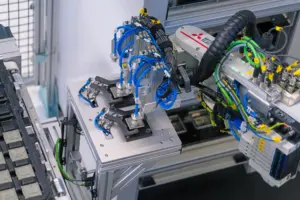
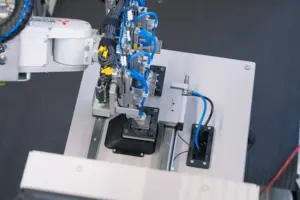
NOFFZ developed a fully automated robotic test cell tailored specifically to these requirements. At the core of the system is an innovative gripper concept developed by NOFFZ for a Mitsubishi industrial robot, featuring four parallel grippers (quattro gripper) that enable the synchronized handling of multiple DUTs.
A key success factor is the consistent parallelization of the test process. Multiple test adapters operate simultaneously, preventing the long test duration of individual modules from becoming a bottleneck. This is complemented by an optimized handling concept without idle movements (“no empty movement”), in which all motion sequences are designed for maximum efficiency.
The test process consists of several coordinated steps:
- Feeding and pre-centering: Transport of untested DUTs via a conveyor belt to a defined position for further processing
- Contacting and testing: Electrical contacting in the test adapter including comprehensive 5G functional testing
- Coplanarity inspection: Verification of the exact position and alignment of the contact points
- Coplanarity station: Inspection of planarity, flatness and solder pad quality (e.g. coplanarity, warpage, pad condition) [anysilicon.com]
- Laser processing: Marking of PASS-tested DUTs with customer-specific identification features to ensure clear traceability
- Laser marking: Marking of passed (OK) DUTs with customer-specific features for permanent traceability of product and measurement data
- Quality separation: Sorting into OK and NOK parts with automatic removal of defective units
- Handling and segregation: Transfer of OK parts into trays and continued transport, while NOK parts are removed via a separate reject conveyor
Through the combination of these technologies, an effective test time of approximately 10 seconds per DUT was achieved – despite individual test durations of several minutes.

Results and Added Value
With the new test solution, the customer successfully transitions from small-batch production to highly automated series production.
Key benefits at a glance:
- Significant increase in throughput through parallelization
- High process stability and reproducibility in end-of-line testing
- Flexible scalability of the system for future requirements (e.g., additional test stations)
- Optimized use of floor space and reduced downtime due to an efficient system layout
- Strengthened competitiveness through scalable production capacity
In addition, the project forms the basis for further joint developments. Additional systems and expansions are already being planned, further reinforcing the long-term partnership.
This implementation clearly demonstrates how demanding testing requirements can be addressed through innovative automation, high-performance robotics, and intelligent system architecture. With this solution, NOFFZ is setting new benchmarks in high-volume end-of-line testing of communication modules and helping customers sustainably optimize their production processes.
Click here to watch the video →